
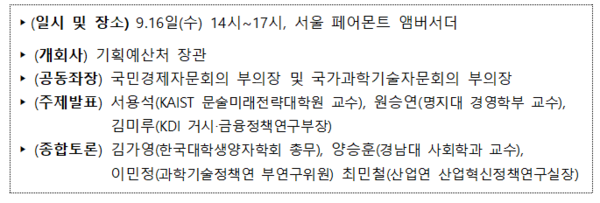
The Budget Office, the National Economic Advisory Council and the National Science and Technology Advisory Council held a joint seminar in Seoul on Sept. 16 under the theme "2045 mid- to long-term national development strategy and walking with the next generation".
The seminar was arranged to discuss the direction of national development to respond to AI, climate and energy transition, demographic structure changes and global supply chain restructuring ahead of 2045, the 100th anniversary of Korea's liberation.
Budget Minister Hong-geun Park (박홍근) presented three goals for South Korea in 2045: "a South Korea that continues to grow through innovation," "a South Korea where innovation is directed toward people's lives" and "a South Korea the world trusts and wants to work with."
Park said, "Past success does not guarantee future success." He stressed the need over the next 20 years to expand investment in AI, advanced technologies and talent, and to resolve regulatory and industrial bottlenecks. He cited proactive investment, structural reform and future planning as the government's role.
The seminar treated youth entry into the labour market amid the spread of AI as a key agenda item. Yong-seok Seo (서용석), a professor at KAIST Graduate School of Future Strategy, proposed shifting existing "youth job creation" policies toward redesigning pathways for accumulating experience.
Seung-yeon Won (원승연), a professor in the business administration faculty at Myongji University, assessed that delayed youth entry into the labour market and asset inequality are factors undermining economic vitality as population decline, low growth and AI innovation proceed at the same time. Won proposed moving away from support-focused youth policies and adopting policies that transfer authority and experience between generations and increase social mobility.
Mi-ru Kim (김미루), director of the Macroeconomic and Financial Policy Research Department at the Korea Development Institute, presented five major transitions: life, innovation, space, generations and the role of the state. In the fiscal area, she stressed that the revenue base and mandatory spending structure should be adjusted in line with demographic and economic structure changes, and that fiscal management should focus on problem-solving effectiveness and cost efficiency rather than the scale of inputs.
Kyung-soo Lee (이경수), vice chair of the National Science and Technology Advisory Council, said, "In the era of the great AI transition, we need to design together the development path of technology and the growth path of people." He said national R&D should not only develop advanced technologies but also provide young people with their first research experience and connect it to sustained careers.
The Budget Office plans to reflect the views raised at the seminar in the process of drawing up the 2045 mid- to long-term national development strategy.
 Jin-ho Lee
jhlee26@d-today.co.kr
Jin-ho Lee
jhlee26@d-today.co.kr