
South Korea’s three telecom operators are accelerating efforts to secure talent to lead AI transformation (AX). As they expand beyond telecoms into AI infrastructure and solutions such as data centres, training job-ready talent has emerged as a key issue.
The three telecom operators are expanding business-to-business services centred on AI infrastructure, the industry said. That has made it a major task to secure people who understand AI models and data, and cloud infrastructure, and can connect them to services.
The telecom industry agrees that investment in AI infrastructure alone makes it hard to speed up business transformation. Even if companies secure large-scale computing resources, monetisation can be delayed if there are not enough people to design and apply them as services. All three telecom operators are focusing on nurturing talent that can apply AI immediately in industrial settings. They are working to secure people who can connect AI knowledge and data, and change services and work processes.
SKT: Finding hands-on talent through hackathons and field-based training
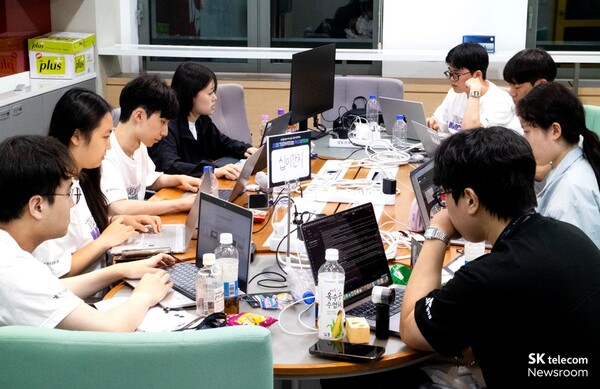
SK Telecom is expanding project-based programmes in which young people use AI to solve real problems. It recently held the 'TECH4GOOD Hackathon' with Hana Financial Group. Participants in its youth AI education programme 'FLY AI Challenger' and Hana Financial Group’s youth talent programme gathered to develop AI services and finance-telecom convergence services. SKT developers took part directly as mentors, sharing technical advice and field experience.
It is also strengthening training that applies AI to telecom operators’ established areas of expertise such as security and networks. It operates 'ALEPH', an AI security and network practical talent training course, as part of the Korea IT Academy and the Labour Ministry’s K-New Deal Academy project.
Trainees carry out tasks similar to real corporate environments, including AI-based network operations and security policy design, corporate infrastructure building, anomaly analysis and breach response. SKT’s policy is to reflect real-world cases and employee mentoring in the curriculum to nurture people who can apply AI to network and security work.
Kim Gu-young (김구영), head of SKT’s Enterprise Business Division, said the importance of capabilities to apply and operate AI in actual work is growing as AI spreads into companies’ core areas.
KT: From 840-hour long-term courses to partnership camps
KT is diversifying its AX talent development system by running external youth education, region-based programmes and in-house employee training at the same time.
Its flagship programme is 'KT Aivle School', which it operates with the Labour Ministry. Since starting its first course in 2021, it has produced about 3,500 graduates. Graduates have entered about 500 companies and are handling digital transformation work not only in AI development and data analysis but also in sales, marketing and planning. The 10th cohort, which starts next month, will receive a total of 840 hours of theory and practical training before carrying out projects.
KT also operates the 'KT K-New Deal Academy' in five regions nationwide. More than half of the curriculum is taught by current practitioners, and it provides projects, visits to group affiliates and job experiences. It also contributes to narrowing regional education gaps by enabling young people outside the capital area to receive the same level of training near where they live.
Along with external talent development, it is strengthening employees’ ability to execute AI. An in-house AI hackathon, 'Agent Camp', which it co-hosted with Palantir in mid-last month, was set up to boost execution capability for B2B business based on Palantir. The aim is to find AI agents for use in real work such as network security monitoring, energy operation optimisation and data building, and apply them in the field.
A KT official said it plans to strengthen forward deployed engineer (FDE) capabilities to solve problems directly at customer sites and boost execution capability for B2B AX business.
LG Uplus: Making employee AI use routine, accelerating internal innovation
LG Uplus is focusing on spreading internal AX that enables existing employees to use AI directly in their work, along with securing specialised personnel with AI capabilities. It has judged that work innovation is possible only if AI is used across all roles, not just by developers.
LG Uplus adopted Microsoft Copilot in May as a company-wide standard work tool and provided training for employees. In about a month after adoption, the employee usage rate exceeded 80 percent and cumulative prompts reached 440,000. About 63 percent of all users were counted as using AI at least once a day.
It is also linking in-house work data with AI for report writing and data classification. Applying AI to some data classification tasks cut working time by about 90 percent. LG Uplus plans to expand support for role-specific AI tools, including vibe coding, service planning and content production.
A telecom industry official said demand is growing for talent with both technical and practical capabilities as AX has emerged as a key issue in the telecom industry. The official said the industry will need to continuously secure field-ready talent to connect investment in AI infrastructure to actual services and revenue.
 Jin-ho Lee
jhlee26@d-today.co.kr
Jin-ho Lee
jhlee26@d-today.co.kr