
[DigitalToday reporter Sangyeop Oh] Regulation will be tightened, including setting per-investor limits for single-stock leveraged products.
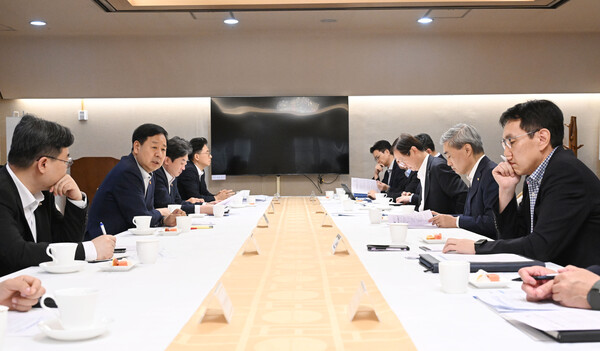
The Financial Investment Association said on July 30 that Financial Investment Association Chairman Seong-yeop Hwang (황성엽) and the heads of asset managers that run single-stock leveraged products, along with securities firms' liquidity provider (LP) executives, held an emergency meeting on July 29 to discuss market stabilisation measures.
Asset managers will first spread rebalancing trades, which had been concentrated near the close, to intraday and after-hours sessions. Leveraged products trade the underlying assets daily to meet target leverage, and the move reflects concerns that such trades clustering near the close can increase volatility in the underlying assets.
Asset managers and securities firms also agreed to cut LP trading volume and closely manage the gap between ETF market prices and net asset values. They will strengthen risk disclosures and investor guidance, and cooperate with government measures including raising minimum deposits and investor education.
The government held an emergency market situation review meeting the same day, chaired by Deputy Prime Minister and Finance and Economy Minister Koo Yun-cheol (구윤철), and presented additional regulatory measures. Bank of Korea Governor Hyun Song Shin (신현송), Financial Services Commission Chairman Kwon Dae-young (이억원), Financial Supervisory Service Governor Lee Chan-jin (이찬진) and presidential office senior secretary for economic growth Ha Jun-kyung (하준경) attended.
The government plans to set per-investor limits on single-stock leveraged exchange-traded funds (ETFs) to manage the overall scale of investment. As an example, it presented a limit of up to 20 percent of an individual's total investment amount.
To curb excessive trading, it is also pushing a plan to raise related transaction costs in a way similar to the excessive order surcharge applied in the futures market. It will add a simulated trading course to existing mandatory education and establish legal grounds to allow market-stabilisation measures such as adjusting leverage multiples in emergencies.
The government plans to establish legal grounds so authorities can take market-stabilisation steps such as adjusting leverage multiples in emergencies when volatility expands sharply, referencing cases such as Hong Kong's flexible leverage.
Earlier, financial authorities raised the minimum deposit for single-stock leveraged ETFs and exchange-traded notes (ETNs) to 30 million won from 10 million won. They also brought forward the implementation date to July 31 from Aug. 5.
Securities firms including Korea Investment & Securities, Mirae Asset Securities and Meritz Securities have also recently informed investors of the revised minimum deposit standard and the implementation date.
As a result, from July 31, investors seeking to buy additional single-stock leveraged ETF and ETN products must hold at least 30 million won in cash in their accounts. Substitute securities such as stocks and bonds are not included in the minimum deposit.
A temporary suspension of new product listings and a ban on securities firms' and asset managers' advertising and event-style marketing are already in effect. Tighter standards for securities firms' management of price discrepancies are due on Aug. 19, and a measure to increase the trading unit from 1 share to 20 shares is set to take effect in November.
The industry judged that after single-stock leveraged products were introduced in May, they drew some overseas investment demand into the domestic regulated market, but the impact on the market became larger than expected as retail trading concentrated in specific stocks and products.
The government said the recent stock market decline was not solely due to single-stock leveraged products. It said weakened investor sentiment and unstable supply and demand amplified losses during a correction after a sharp rise in share prices, and assessed that the fundamentals of the domestic economy were solid given semiconductor exports, corporate earnings forecasts and the current account. Hwang said, "We will swiftly implement voluntary measures such as spreading rebalancing trades and managing LP trading volume," and added, "We will work closely with the government to stabilise the market and protect investors."
 Sangyeop Oh
yub@d-today.co.kr
Sangyeop Oh
yub@d-today.co.kr