
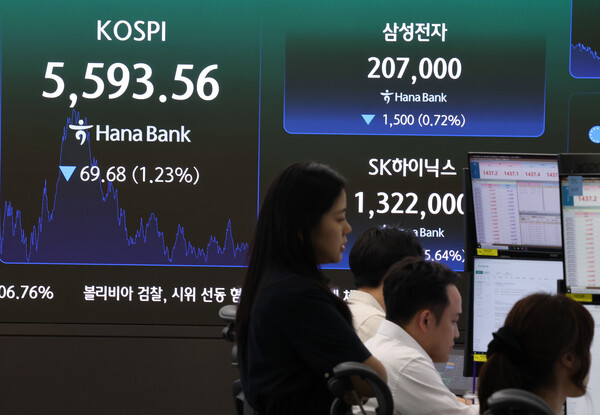
South Korea's KOSPI slid below the 5,600 level, failing to overcome weakness in semiconductor and information technology parts shares despite net foreign buying worth more than 1 trillion won. The Kosdaq also fell more than 2 percent, extending domestic stocks' decline to a third straight session.
On July 30, the KOSPI closed down 69.68 points, or 1.23 percent, at 5,593.56. It rebounded early in the session to regain the 5,700 level, but gave up gains in the afternoon and turned lower.
In the main board market, retail investors net sold 1.4199 trillion won. Foreign investors net bought 1.3299 trillion won and institutions net bought 66.6 billion won, supporting the lower end of the index.
A sharp overnight drop in U.S. semiconductor shares weighed on large-cap chipmakers in South Korea. Micron fell nearly 10 percent and the Philadelphia Semiconductor Index dropped 5.33 percent. A hawkish interpretation of the July Federal Open Market Committee meeting and rising oil prices driven by U.S.-Iran tensions also pressured investor sentiment.
Samsung Electronics closed down 0.72 percent at 207,000 won. SK Hynix plunged 5.64 percent to 1,322,000 won.
SK Square fell 6.00 percent to 799,000 won. Samsung Electro-Mechanics slumped 14.58 percent to 879,000 won, marking the biggest drop among top market-cap stocks.
LG Energy Solution, meanwhile, rose 6.49 percent to 320,000 won, and Samsung Biologics gained 3.25 percent to 1,527,000 won. KB Financial Group also climbed 4.56 percent to 167,400 won, showing a different trend from semiconductor shares.
Hyundai Motor closed down 0.71 percent at 351,000 won, while Samsung Life Insurance fell 0.56 percent to 264,000 won.
The Kosdaq ended down 17.90 points, or 2.70 percent, at 644.78. It attempted an intraday rebound, but selling expanded in the afternoon and it finished near the day's low.
In Seoul's foreign exchange market, the won was at 1,437.70 per dollar, 8.30 won higher than the previous session. Despite the weaker dollar and net foreign buying, concentrated selling pressure in semiconductors limited any rebound in the index.
Brokerages said the recent sharp drop is driven more by worries about slowing artificial intelligence investment, expanded output by Chinese memory firms and reduced risk appetite tied to uncertainty over monetary policy than by a full-fledged deterioration in corporate earnings.
Lee Jae-won (이재원), an analyst at Yuanta Securities, said the semiconductor industry's structural growth potential has not turned down. He called the current decline an excessive correction compounded by a psychological shock.
Han Ji-young (한지영), an analyst at Kiwoom Securities, said worries are building over semiconductors passing a profit peak and the end of the AI investment cycle, but a full-fledged cut in earnings estimates has not appeared. She said a recovery scenario that recoups recent losses should take priority over expectations of an extreme further decline.
 Oh Sang-yup
yub@d-today.co.kr
Oh Sang-yup
yub@d-today.co.kr