
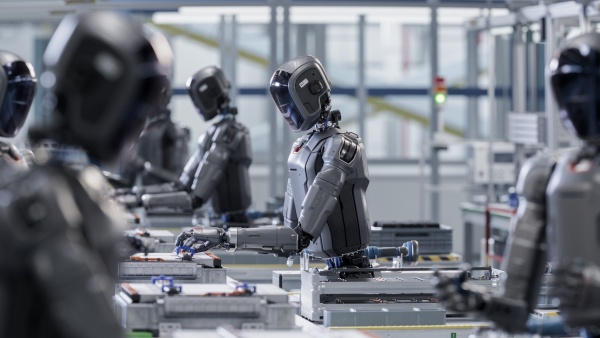
The United States has effectively blocked new imports and sales of foreign-made advanced robots, putting the brakes on Chinese robot makers’ strategy to expand in the U.S. market.
On July 29, the South China Morning Post reported that the U.S. Federal Communications Commission a day earlier added foreign-made “advanced robotic devices” to its covered list and blocked issuance of new certifications required for import and sale in the United States.
The targets include humanoids, quadruped robots and various connected mobile robots. The FCC cited supply-chain vulnerabilities and cybersecurity threats. Models that already have certification are not affected for now.
The move is expected to directly burden Chinese firms that hold an advantage in the global robot market. Counterpoint Research data showed Chinese companies accounted for more than 80 percent of humanoid robots installed worldwide last year. China’s Ministry of Industry and Information Technology said Chinese firms took about 70 percent of global quadruped robot sales in the first half of this year, and that China-developed humanoid models number more than 400, exceeding half of the global total.
The Chinese government immediately pushed back. Mao Ning (마오닝), a spokesperson for China’s foreign ministry, said at a July 30 briefing that China has consistently opposed the United States expanding the concept of national security to suppress Chinese companies. She said protectionism cannot boost U.S. competitiveness and would only harm U.S. companies and consumers, and said China would take necessary steps to protect the legitimate rights and interests of Chinese companies.
The market is also focusing on the timing of the regulation. It coincides with a period when Chinese robot firms are making overseas markets a growth engine and some are preparing for listings. Soumen Mandal (수멘 만달), a senior analyst at Counterpoint Research, said the timing of the move is “unlikely to be a coincidence” and pointed to multiple Chinese humanoid companies preparing initial public offerings this year. He said U.S. companies such as Tesla, Figure and Boston Dynamics would be big beneficiaries of the move.
Many Chinese firms also have high exposure to the U.S. market. How much impact the move will have on the broader industry remains uncertain. Many companies do not disclose U.S. revenue separately, but have presented overseas expansion as a core growth strategy. Chinese customs data released last week showed China’s exports of industrial, cleaning, surgical and bionic robots in June were close to $600 million, with about 8 percent shipped to the United States.
Unitree Robotics generated more than 40 percent of revenue from its core business overseas last year. Key overseas revenue was 732 million yuan. The company has recently partnered with Nvidia to develop a new humanoid, “Isaac GR00T,” scheduled for launch within the year, but the restrictions have raised uncertainty over whether the model could be subject to U.S. certification requirements.
Executives at Shanghai-based AgiBot have said they expect about 30 percent of total revenue this year from overseas markets and that it could exceed 50 percent in the long run. The United States is one of the company’s target markets. Shenzhen-based Pudu Robotics said it opened its U.S. headquarters in Dallas, Texas early this year and deployed about 15,000 robots in the Americas. Revenue in the region surged 285 percent from a year earlier. Warehouse logistics robot firm Geekplus recorded U.S. revenue of 839 million yuan last year, accounting for about 26.5 percent of total revenue.
The regulation also includes an exception channel. The FCC said foreign manufacturers can request that the devices be removed from the covered list with approval from the Department of Defense. Industry sources, however, view the move as part of a broader manufacturing reshoring policy rather than a simple certification rule. Hunter Su (헌터 수), a regulatory compliance specialist at the Shanghai Artificial Intelligence Technology Association, said the current administration treats reshoring manufacturing itself as a national security issue, and sees dependence on overseas supply chains as a security flaw and production outside the United States as a strategic vulnerability.
As a result, Chinese robot firms are increasingly likely to have to review their approaches to the U.S. market and their production and certification strategies. Products that already have certification can continue to be sold for now, but growth strategies centered on new models have run directly into the U.S. regulatory threshold.
 Seungah Yoo
ysah@d-today.co.kr
Seungah Yoo
ysah@d-today.co.kr