
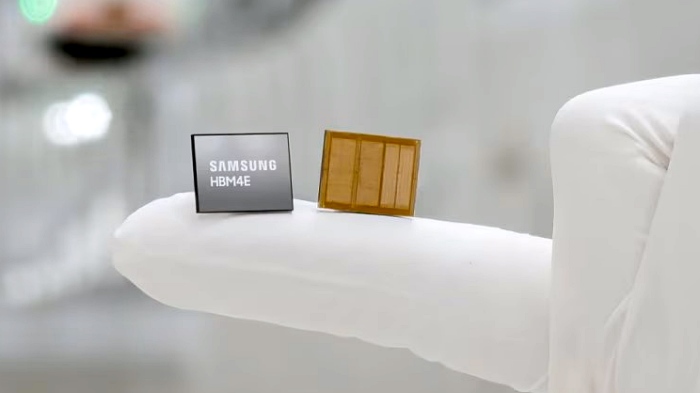
Samsung Electronics plans to tie 60 to 70 percent of its memory production capacity to multi-year supply contracts. It has completed contracts with five major global data centre customers and is in the final stage of finishing negotiations with five additional large customers linked to AI demand. The company aims to reshape its memory business into an order-based structure, rather than one that swings with the market cycle.
Jaejoon Kim (김재준), executive vice president and head of strategy marketing at Samsung Electronics' memory business, said on July 30 in the company's 2026 second-quarter earnings conference call, "If the contracts currently under negotiation are completed, multi-year contract volumes for both DRAM and NAND should be sufficient to reach 60 to 70 percent of the capacity we are planning." Samsung Electronics plans to place 60 to 70 percent of total capacity under long-term contracts to secure supply flexibility.
Second-quarter results formed the backdrop to the talks. Kim said both DRAM and NAND achieved record-high bit shipments in the second quarter, and the share of bit sales for server applications also hit a record. DRAM bit shipments rose by a low-teens percentage from the previous quarter, exceeding the company's guidance. Second-quarter ASPs rose by a mid-40 percent range for DRAM and a high-60 percent range for NAND from the previous quarter.
The contract structure is a rolling arrangement based on a five-year term. Kim said Samsung Electronics is signing contracts with a five-year base and adding one more year each year through annual negotiations. To increase enforcement, the company included prepayments with a deposit-like character in the contract terms, and it has already received about one quarter of that amount.
Samsung Electronics did not disclose the size of the prepayments, citing NDAs with customers. The company plans to establish this contract structure to secure a certain level of medium- to long-term order-based business. Kim said it applies different pricing models depending on customer and product groups, and for commodity products it has set a floor price at a level that can offset future investment risks from market price swings.
Customers are rushing to sign contracts amid expectations that supply shortages will last. Kim said that considering a lead time of more than 3.5 years from building new fabs to wafer production, it would be difficult to expect a sharp increase in supply through 2028. The company expects demand unmet this year to be pushed into next year, deepening supply shortages in 2027 versus this year and extending into 2028.
The path through which demand arrives has also changed. Kim said AI frontier model companies that could not secure enough cloud service capacity from hyperscalers asked neo-cloud companies for additional allocation, which in turn led to large memory supply requests from server OEMs that have neo-cloud firms as customers. He said companies that still could not secure volumes began sharing medium- to long-term demand outlooks, conveying intentions to buy directly from Samsung Electronics and requesting multi-year supply contracts.
◆Rolling five-year base contracts... one quarter of prepayments received
Product demand remains high in the second half. Kim forecast that third-quarter HBM4 revenue will expand by more than three times from the previous quarter, and that on a second-half basis HBM4 revenue will account for more than 60 percent of total HBM revenue. He said demand is expanding in line with the ramp-up pace in the second half as customer evaluations for each task are completed. Kim said Samsung Electronics is expanding supply capability through monthly capacity increases and yield improvements, and that discussions on 2027 HBM supply have already been completed with key customers.
NAND market conditions are also shifting toward servers. Kim forecast that server SSDs will account for more than 60 percent of the company's NAND revenue this year, up by more than 20 percentage points from the previous year. He said the company has already secured performance-related feedback on PCIe 6th-generation SSDs from major customers, and that V10 NAND using bonding and three-tier stacking technology has entered mass production in August. He forecast QLC product bit shipments will expand by more than two times in the second half versus the first half.
Kim said, "We operate a balanced customer portfolio that is not overly concentrated on any particular customer, and we are reflecting this principle in multi-year supply contracts as well." He said customers that have already signed contracts are also asking for additional supply increases, so the number of contracted customers is expected to rise over time. Third-quarter bit growth guidance was presented as a mid-single-digit increase for DRAM and a high-single-digit increase for NAND. He said inventory levels for both DRAM and NAND are noticeably low.
There was no mention of a price ceiling. If the floor price is a defence mechanism during downturns, the extent to which market prices can be reflected during upswings will determine profitability. Samsung Electronics avoided giving a clear answer on this point. The company said only that it aims to reflect in contracts a pricing model at a level that offsets a certain degree of future investment risk. With 60 to 70 percent of capacity tied to long-term contracts, results could vary depending on the price elasticity of the remaining volumes. Kim stressed that in a market environment where supply constraints are expected next year as well, the company will pursue balanced operations targeting similar levels of share for HBM and conventional DRAM.
 Daegeon Seok
d2dg@d-today.co.kr
Daegeon Seok
d2dg@d-today.co.kr