
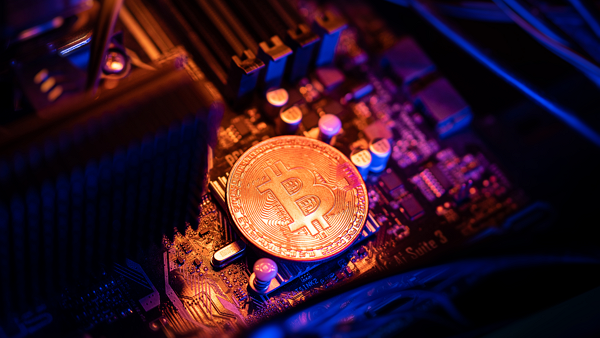
Bitcoin mining companies are shifting power and equipment to artificial intelligence (AI) infrastructure to counter worsening profitability.
On July 29, local time, blockchain media outlet CryptoSlate reported that some large miners have already begun converting facilities and signing long-term computing contracts. They are also cutting investment in new mining equipment.
The backdrop is a deteriorating mining environment. Bitcoin is trading around $64,000, about 50 percent below its October 2025 peak. Network competition has intensified, while transaction-fee revenue remains weak. The April 2024 halving also cut the block reward to 3.125 BTC from 6.25 BTC.
Mining profitability indicators are also weak. VanEck said miners' daily revenue fell about 40 percent from a year earlier, and the 30-day average recently stood at about $28.5 million. Hashprice fell to near record lows earlier this year and is now stuck around $30 per petahash per second (PH/s). Operators with high power costs or older equipment could be pushed below break-even.
AI data-centre operators, by contrast, are offering higher power rates and long-term contracts. That allows miners to monetise power assets that cannot generate sufficient returns from bitcoin mining alone. Fred Thiel (프레드 틸), chief executive of Mara Holdings, said in a recent interview, "If you supply power to AI, you can make more money than bitcoin mining."
The profitability gap was also large. The gross margin for the colocation business was 59 percent, but the gross margin for self-mining was negative.
A similar trend is emerging across listed miners. CoinShares tallied the cumulative value of AI and high-performance computing (HPC) contracts announced by listed miners this year at more than $70 billion. It also estimated that by the end of 2026, up to 70 percent of listed bitcoin miners' revenue could come from AI businesses. The current share of AI revenue is about 30 percent.
Some in the industry argue the timing of the shift may not be appropriate. Andre Dragosch (안드레 드라고슈), head of research at Bitwise Europe, raised the possibility that miners are moving at the wrong point in the market cycle. He said AI compute demand, including for autonomous agents, may not materialise as quickly as the market expects.
At the same time, he judged the bitcoin market to be nearing the tail end of the current downturn. If bitcoin prices recover while miners keep capital and power capacity tied up in AI businesses over the next year, mining economics could revive, he said. Dragosch said in that case some companies that have changed direction now could regret the decision within the next 12 months.
The issue is that shifting to AI is not an easily reversible investment. CoinShares said the cost of building bitcoin mining infrastructure is about $700,000 to $1 million per megawatt (MW), but AI facilities require about $8 million to $15 million per MW.
Another variable is that AI facilities require far more capital and longer payback periods than mining equipment. Application-specific integrated circuits (ASICs) ordered for bitcoin mining cannot be used for AI computation performed by graphics processing units (GPUs), making it impossible to convert existing equipment as-is. That means assets miners can use for AI businesses are limited to power, grid-connection rights, land and data-centre infrastructure.
Another variable is that investment in AI infrastructure is surging across the technology industry. The Bank for International Settlements (BIS) estimated that AI-related capital spending by the five hyperscalers in 2025 and 2026 could exceed $1 trillion.
Ultimately, the key is the time lag between AI demand and infrastructure supply. Even if AI demand rises over the long term, the high profitability now drawing in miners could weaken if supply expands faster than commercial demand. At the same time, if bitcoin prices or hashprice recover, the profitability gap between mining and AI businesses could narrow. Companies that have already committed billions of dollars and power capacity to long-term computing projects are expected to find it harder to respond flexibly to market changes.
 Yoonseo Lee
yslee@d-today.co.kr
Yoonseo Lee
yslee@d-today.co.kr