
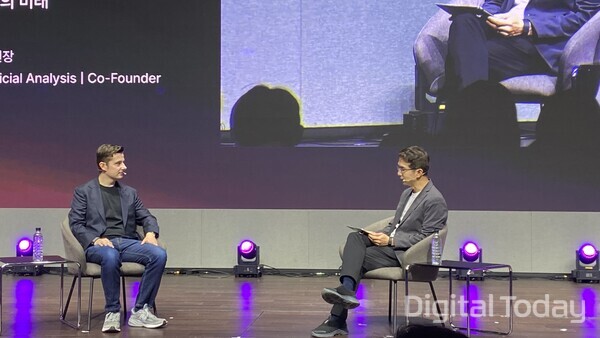
A global AI assessment group said South Korea has quickly risen to become one of the world’s three leading AI countries, driven by its sovereign AI foundation model project. It said South Korean models still trail top U.S. and Chinese models on intelligence, but the country should build on strengths such as manufacturing and science while continuing the race for artificial general intelligence (AGI).
George Cameron (조지 캐머런), co-founder of global AI benchmark group Artificial Analysis (AA), spoke in a dialogue with Honglak Lee (이홍락), co-head of research at LG AI Research, at the "LG AI Talk Concert 2026" hosted by LG AI Research on Sept. 14. "The pace of development of South Korea's AI ecosystem is very fast and impressive," he said. "It is not currently leading the AGI race, but it needs to keep AGI in mind and develop general-purpose capabilities."
Cameron cited domestic AI companies and the government's sovereign AI foundation model project as drivers of South Korea's AI growth. "You can see how quickly South Korea has developed over the past year," he said. "Credit is also due to the efforts of South Korean AI companies and government support through the sovereign AI foundation model project."
AA assessed South Korea as one of the world's current "top three AI countries." "South Korea is clearly a leading country in sovereign AI," Cameron said. "South Korea's sovereign AI initiative can become a model that can inspire other countries."
He said it was still too early to say South Korean models have reached the global frontier. Asked by Lee about the gap between South Korean AI models and global frontier models, Cameron replied, "In terms of intelligence, they still lag leading U.S. and Chinese models."
He said model competitiveness should not be judged solely by intelligence scores. Costs can differ by more than 100 times between models, and open-weight models allow companies to run them directly on their own hardware or tailor them to their purposes. He said regional capabilities such as Korean-language performance can also be a reason to choose South Korean models.
AA analyzed that frontier-level open-weight models remain about 3 to 9 months behind top closed models in intelligence. It forecast the value of using open-weight models would persist, given corporate demand that prioritizes cost efficiency and flexibility.
Lee also pointed to limits of benchmark assessments. He asked how it is possible to distinguish performance gains from becoming accustomed to benchmarks from actual improvements in a model's intelligence, given that some models can become excessively optimized for specific, widely known benchmarks.
In a second evaluation of the sovereign foundation model project, AA's intelligence index, AAII, was a key metric with the highest weight among benchmark categories. But controversy emerged over the evaluation method after Motif Technologies, which received the top score, was eliminated and LG AI Research, which received the lowest score, advanced.
Cameron said, "AAII is made up of 10 evaluations, preventing performance improvements focused on a single benchmark from being overestimated as growth in overall model capability."
He added that about 50 percent of the latest AAII consists of non-public test sets. He said the methodology is disclosed but the actual questions are not, and benchmarks are continuously updated to prevent excessive optimization to specific evaluations.
Cameron emphasized that South Korea should focus on advanced manufacturing and corporate knowledge work, where it has strengths, while continuing to develop general-purpose intelligence that supports such specialized capabilities.
"It can focus on important use cases for South Korea, such as advanced manufacturing or corporate knowledge work," he said. "But language models implement specific expertise based on general-purpose intelligence, so even if South Korea's AI ecosystem is not leading the AGI race, it should continue developing general-purpose capabilities."
He also cited AI for science, agents and coding skills as technologies South Korea should strengthen. "AI for science is an area where AI can have a huge impact," he said. "Knowledge-work agents that can work for long periods, and coding capabilities that enable real actions in the real world, are also important."
AA forecast that future AI evaluations will also shift from simple question-and-answer abilities toward actual job performance.
"One of the important benchmark areas going forward is agentic knowledge work," Cameron said. "It will become important how much AI can do what people actually do at companies, such as sending emails, making PowerPoint presentations and conducting Excel analysis."
He also said that if a problem occurs on a manufacturing line, an agent should detect it on its own, take necessary actions and inform people of the results. He forecast a move from "reactive" agents that wait for human instructions to "proactive" agents that assess situations and act on their own.
 Seul-gi Son
sageson@d-today.co.kr
Seul-gi Son
sageson@d-today.co.kr