
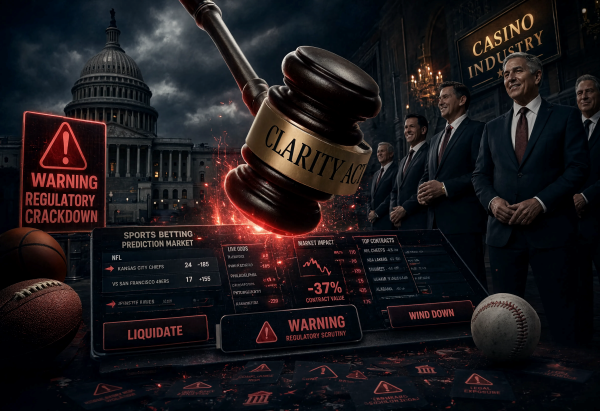
[Digital Today reporter Yoonseo Lee] A claim has been made that the Clarity Act being discussed in the U.S. Congress could provide grounds to expand the Commodity Futures Trading Commission's oversight authority over prediction markets.
On July 21 local time, Cointelegraph reported that at a hearing of the House Agriculture Committee's Subcommittee on Commodity Markets, Digital Assets and Rural Development, legal experts focused on oversight gaps around sports event prediction markets and conflicts between federal and state regulations.
The issue at the hearing was how far the CFTC can oversee prediction market platforms such as Kalshi and Polymarket. Carl Kennedy (칼 케네디), a lawyer at New York law firm Katten Muchin Rosenman, said the CFTC would find it difficult to sufficiently handle regulation and enforcement of such platforms with its current staffing alone. He argued that if the Clarity Act for the digital asset market passes, the CFTC could receive additional authority to cover not only digital assets but also the rapidly growing prediction market.
The remarks coincide with growing controversy over regulatory interpretations under CFTC Chairman Michael Selick (마이클 셀릭). Confirmed by the Senate in December last year, he has pushed the position that the CFTC has exclusive jurisdiction over prediction market companies. Selick views event contracts on those platforms as swaps that fall under the CFTC's jurisdiction. The CFTC currently has only one Senate-confirmed official, Selick, unlike its usual leadership structure of five commissioners.
Democratic senators are pushing back against that interpretation, saying it is an attack on state governments' regulatory authority. In fact, some state governments have filed lawsuits against Kalshi and Polymarket, citing sports betting concerns. Last week Selick ordered Kalshi not to follow a Michigan state court ruling, and Kalshi said the move left it in an awkward position between state governments and federal authorities.
In legal circles, there is also a view that this jurisdictional conflict could ultimately lead to a Supreme Court ruling. Some prediction market cases could become benchmark cases defining the boundary of authority between state governments and federal regulators.
Discussions on legislation for the Clarity Act are also accelerating. Republican senators are pushing for a vote on the Clarity Act before Congress recesses in August, and they expect the bill text to be released soon. As of July 21, however, it has not been disclosed how prediction market issues will be reflected in the bill or how lawyers' ethical concerns will be incorporated.
The gambling industry has also launched a separate response. Related groups asked the U.S. Senate in June to include language in the Clarity Act explicitly banning event contracts tied to sports and casino-style games. The White House also confirmed that the Trump administration agreed to what it called "the most comprehensive and wide-ranging ethics provisions ever" in order to reflect Democratic concerns.
Ultimately, the key question in this debate is whether the Clarity Act, which started as a crypto market structure bill, can also touch the regulatory framework for prediction markets. With issues intertwined including expanded CFTC authority and staffing, jurisdictional conflicts with states and the permissible scope of sports event contracts, future bill wording and court rulings are expected to determine the direction of the prediction market industry.
 Yoonseo Lee
yslee@d-today.co.kr
Yoonseo Lee
yslee@d-today.co.kr