
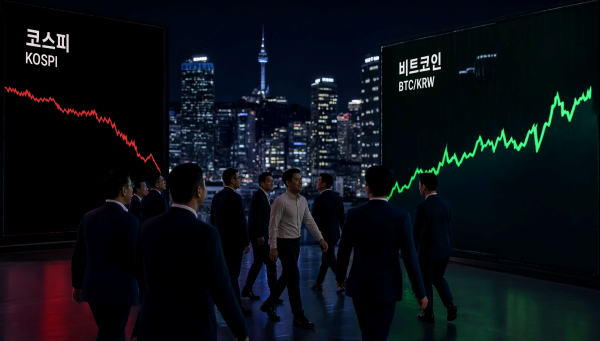
With the KOSPI plunging 8.95 percent in a day and its intraday loss widening to as much as 15 percent, risk appetite across South Korea's financial markets is being shaken. The market is watching whether money exiting stocks moves to cryptocurrencies such as bitcoin, or whether selling pressure continues across risky assets.
On July 13 local time, blockchain media outlet Cryptopolitan said the drop showed the recent KOSPI rise had been a fragile structure heavily reliant on leverage, and raised the possibility that the impact could spread to the cryptocurrency market.
The KOSPI extended a strong rally in June and at one point rose to 9,155 points, but has been pushed down quickly below the 6,800 level over the past month. With a high share of leveraged investing, analysts said the possibility of additional margin calls and forced liquidations remains. A circuit breaker was triggered during the plunge, sharply increasing market volatility.
Semiconductor and artificial intelligence-related stocks were at the center of the adjustment. As expectations for the semiconductor cycle that had driven the KOSPI higher weakened, the market began to question the sustainability of future earnings. The KOSPI's forward price-to-earnings ratio is currently about 6.4 times, falling to the lowest level since the 2008 global financial crisis. Analysts said this reflects market anxiety over whether the strong earnings of semiconductor companies can be maintained, rather than simple undervaluation.
Semiconductor-related indicators also swung sharply. An index linked to Hynix fell more than 19 percent over the past week, and the KOSPI logged its seventh circuit breaker of the year. The market said retail investors' leveraged liquidations are proceeding faster than expected, and that the current investment view on the KOSPI has deteriorated to a level of "strong sell".
Investors are focused on where money leaving the stock market will go. During the earlier surge in the KOSPI, some retail funds that had been flowing into the domestic cryptocurrency market were assessed to have moved into stocks. After the latest plunge, if appetite for risky assets holds, some funds could flow back into bitcoin and major cryptocurrencies, it said.
But analysts say that if investor sentiment shrinks sharply, it cannot be ruled out that funds could leave both stocks and cryptocurrencies, leading to a risk-off phase.
The cryptocurrency market has already been affected. Bitcoin fell after failing to break above $64,000 in tandem with the KOSPI plunge, and has since been trading again around $63,000.
Cryptopolitan said major cryptocurrencies including bitcoin have shown a high correlation with risky assets this year, repeating a pattern in which shocks in other asset markets are quickly reflected in cryptocurrency prices.
Volatility also expanded in derivatives markets. On decentralised derivatives platform Hyperliquid, volatility in stock perpetual futures trading increased, while products linked to Samsung Electronics fell 8.38 percent in a day as trading volume surged. As the semiconductor-sector adjustment affected HIP-3-related trading, the market raised the possibility of additional liquidations and liquidity changes.
Moves by foreign investors are also a variable. Overseas inflows played a big role in the KOSPI's rally, but foreign investors have turned net sellers since late June. Based on this year's high, the KOSPI was up about 122 percent from the start of the year, but the latest plunge has narrowed the gain to about 60 percent.
The market also sees how U.S. stocks react after Asian markets close as an important variable that will determine the direction of risky assets.
Ultimately, the KOSPI's sharp drop has emerged as a variable testing not only an internal correction in South Korea's stock market but also fund flows and risk sentiment in the cryptocurrency market. The near-term focus is whether retail funds flow back into digital assets or whether a risk-off phase continues that drags down both stocks and cryptocurrencies.
 Jinju Hong
hongjj@d-today.co.kr
Jinju Hong
hongjj@d-today.co.kr