
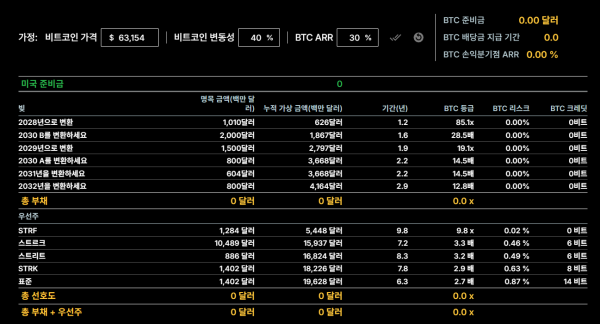
[DigitalToday reporter Yunseo Lee] Strategy has released an interactive credit model that can calculate in real time its debt and capacity to pay dividends even if the price of Bitcoin does not rise.
On July 9 local time, blockchain outlet U.Today reported that the release came two days after Strategy officially confirmed it sold 3,588 bitcoins worth $216 million to fund preferred dividends and secure dollar liquidity.
The tool appears aimed at responding to Wall Street's risk debate over Strategy's business model. It is intended to show in numbers how long the company can meet obligations even without a Bitcoin bull market. Michael Saylor (마이클 세일러), who leads the company, said on social media, "Digital Credit is transparent because the principal market risk factor is Bitcoin."
The baseline figures the company presented show the defensiveness of its current capital structure. By the key metric of "years of dividend capacity," it calculates that even if Bitcoin market growth stops completely, it can meet dividend obligations without interruption for 30 years with about $52.87 billion in crypto reserves and $2.55 billion in dollar reserves.
It also presented a break-even structure. Strategy said that to pay all coupons and dividends stably without new fundraising, Bitcoin only needs to rise an average of 3.33 percent per year. The company stressed that it can maintain the current structure with only a minimum rate of increase, not a sharp rally.
It also disclosed debt coverage figures. Total obligations are $22.178 billion, combining $6.714 billion in convertible bonds and $15.464 billion in preferred stock. By contrast, the current asset coverage indicator, the "BTC rating," was presented at 2.7 times. The company explained that this figure supports payment stability to investors even in a long-term correction market.
This explanation coincides with recent changes in its fundraising structure. Strategy has long maintained a Bitcoin-accumulation-focused strategy, but its operating approach changed after the launch of the STRC debt product. After the volume-weighted average market price of STRC stock fell below its $100 par value in July, the company raised the dividend rate to 12.00 percent to defend the market price.
The higher dividend burden increased the need for regular fiat currency inflows. Strategy therefore used a board-approved Bitcoin cash-out program of up to $1.25 billion. The company's recent partial sale of Bitcoin is also linked to this payment structure.
Saylor's side is presenting this not as a simple response to a liquidity shortage but as part of a new capital structure. The company sees controlled cash-outs of reserve assets as being included in its "Digital Credit capital framework." It also made clear it is moving to a flexible asset-management system rather than an existing passive holding strategy.
Against this backdrop, the calculator also sends a message to the risk-judgment structure centered on credit rating agencies. It is as if Strategy is seeking to show investors directly the formula for debt sustainability in response to S&P's speculative-grade assessment. Strategy's core claim is that it will transparently verify whether its payment structure can be maintained even under conditions where the Bitcoin market does not keep rising.
Digital Credit is transparent because the principal market risk factor is Bitcoin, an observable, homogeneous asset. Analysts can assess BTC-related credit risk continuously, and investors can apply their own statistical models to inform valuation and trading decisions. $STRC pic.twitter.com/6Xo63MEmeM
 Yunseo Lee
yslee@d-today.co.kr
Yunseo Lee
yslee@d-today.co.kr