
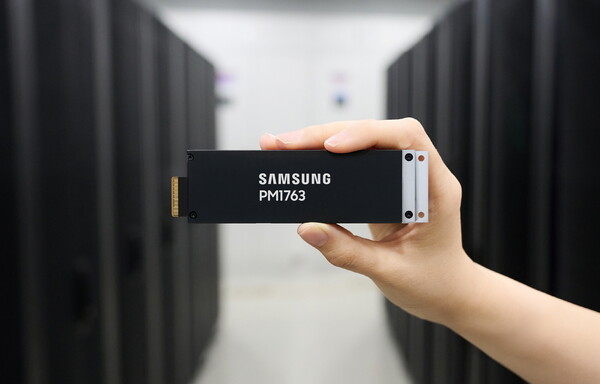
Samsung Electronics is stepping up its business related to building AI infrastructure. Samsung Electronics said on Tuesday it has started mass production of the PCIe 6.0 enterprise SSD (eSSD) PM1763, which uses ninth-generation V-NAND and a 4-nanometre-based controller to boost performance and power efficiency.
As the amount of data needed for AI training and inference increases rapidly, enterprise SSDs that can supply it stably and quickly have emerged as a core component of AI infrastructure. PM1763 is based on PCIe 6.0, which uses the PAM4 method that divides signals into four levels for transmission, doubling data bandwidth compared with the previous standard. This reduces data latency between accelerators and storage devices to increase AI server processing speed.
PM1763 will be offered in 3 capacities: 4 terabytes (TB), 8TB and 16TB, and the 16TB product delivers the industry's best performance. Based on the 16TB model, sequential read and write speeds are up to 28,400 megabytes (MB) per second and 21,900 MB per second, about twice as fast as the previous PM1753. That is fast enough to transfer 40 gigabytes of data, compressed to 4 bits from a model with 70 billion parameters, in about 1.4 seconds, minimising data latency between accelerators and processors.
PM1763 is optimised for liquid-cooling environments used in next-generation AI servers. It applies a D2C (Direct-to-Chip) cooling method that cools heat by attaching a cold plate directly to components, maintaining top performance for long periods without performance degradation even under high loads. Power efficiency improved by more than 1.8 times compared with the previous model, which can also help cut data centre operating costs.
The product also strengthens security features to match an AI era in which data security is becoming more important. It prevents quantum computing-based hacking by using a PQC (Post-Quantum Cryptography) encryption algorithm that addresses weaknesses in existing encryption methods that are vulnerable to hacking attacks by quantum computers. It also applies TDISP, a PCI-SIG standard technology that blocks unauthorised external intervention when an SSD is allocated to host resources and a connection is formed in a virtualised environment, protecting the data path securely.
Jangseok Choi (최장석), an executive director in the Product Planning Team of Samsung Electronics' Memory Business, said PM1763 met global customers' requirements for next-generation AI platforms based on the industry's best performance and also successfully completed product validation. He said the product will be a key solution that expands memory capacity to support customers' AI models operating efficiently.
 Seok Dae-geon
d2dg@d-today.co.kr
Seok Dae-geon
d2dg@d-today.co.kr