
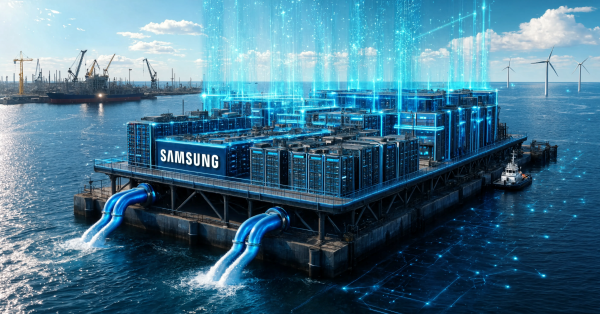
Samsung Heavy Industries aims to commercialise floating data centres by the second quarter of 2028.
Shipbuilding and securities industry sources said on July 7 local time the company is also pursuing a plan to secure orders before installation.
The plan comes as land-based data centres face growing burdens from power and water use, opposition from local communities and a shortage of sites. It also aligns with a broader push across the cloud industry to find new locations as artificial intelligence (AI) drives up demand for computing.
Samsung Heavy Industries is reviewing a plan to develop a dedicated barge-style platform that would carry servers, power facilities and onboard power supply equipment together. In the initial build-out, it would mainly use land-based electricity connected to the existing power grid, while placing the facility on the water surface to reduce cooling burdens. The company believes the water environment has more stable temperatures than on land, offering an advantage in cooling efficiency.
The power configuration could be expanded further. Earlier concepts included solid oxide fuel cells based on liquefied natural gas (LNG), and renewable sources such as solar and wind were also mentioned as options.
Samsung Heavy Industries sees floating data centres as potentially having an edge over land-based facilities in build speed. It can avoid part of the lengthened permitting process and use production processes and equipment already in place in shipbuilding. Samsung Heavy Industries CEO Seong-an Choi (최성안) said floating data centres are a "significant new opportunity for the shipbuilding and offshore industry."
Still, there are substantial technical challenges. IT outlet TechRadar cited seawater ingress and humidity control, corrosion from salinity, and securing stability amid changes in currents and tides as representative issues. The company has presented a commercialisation timeline, but verification of these variables will be needed during actual installation and operations.
Floating data centres are not an area only Samsung is reviewing. Panthalassa, a startup backed by Peter Thiel (피터 틸), is developing floating data centres using wave energy and seawater cooling. In Japan, Hitachi signed a memorandum of understanding in March 2026 with shipping company Mitsui O.S.K. Lines to develop and operate related facilities.
Experiments with offshore and underwater data centres are also continuing in China. Chinese authorities and HiCloud Technology said they jointly 추진했다 an undersea data centre project worth $226 million. The facility is designed at a capacity of 24 megawatts (MW) and uses passive cooling with seawater to handle AI work, 5G services and large-scale data annotation tasks.
Microsoft has also tested underwater data centre capsules through Project Natick near Scotland and California in the past, but halted commercial development.
Amid these trends, data centre location strategies are gradually diversifying away from a land-centric approach. If Samsung Heavy Industries' plan leads to actual orders and installation, it could become a case of expanding shipbuilding-based manufacturing capabilities into the data infrastructure business. Whether floating data centres can become a realistic alternative to solve power and cooling challenges in the AI era will be a point to watch.
 Seung-a Yoo
ysah@d-today.co.kr
Seung-a Yoo
ysah@d-today.co.kr