
The Korea Broadcasting Media Communication Commission designated "large information and communications service providers" following the enforcement of the revised Act on Promotion of Information and Communications Network Utilization and Information Protection.
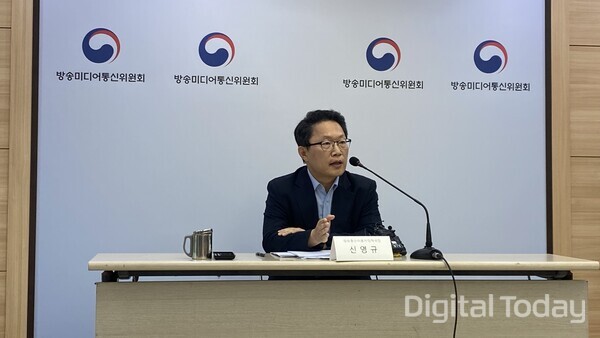
Shin Young-kyu (신영규), director-general of the commission's Broadcasting and Telecommunications Users Policy Bureau, said at a Network Act enforcement briefing at the Government Complex in Gwacheon on July 8 that the commission notified the relevant companies by official letter on Tuesday morning that they had been designated as regulatory targets. Companies that disagree can submit an explanation within 1 week of the notification date. If no explanation is submitted, the designation takes effect 1 week later.
The eight large information and communications service providers designated by the commission are four domestic platforms - Naver, Kakao, Nate and DC Inside - and four overseas operators - Google, Meta, X and TikTok.
The revised Network Act imposes obligations on large platforms with at least 1,000,000 daily active users to set up systems to report and handle illegal and fabricated information and to establish self-regulation operating policies. It makes those who intentionally disseminate fabricated information and cause harm to others liable for civil damages, and allows claims for punitive damages of up to 5 times against posters who publish for profit. A fine of up to 1 billion won can also be imposed for distributing at least twice information ruled illegal or fabricated by a final court judgment.
Under the revised law, the designated companies are obligated to support fact-checking activities, including receiving and processing reports of illegal and fabricated information, establishing self-regulation operating policies, publishing transparency reports twice a year, and signing agreements with fact-checking organisations. When a report is received, they must notify the reporter that it has been received and must also notify both the reporter and the reported party of the results of any action taken.
Asked about criticism that reporting functions for fabricated information remain inadequate on the platforms despite the law taking effect, Shin said the law requires platforms to notify the reporter upon receiving a report and to notify both the reporter and the reported party of the results of measures taken. He said the commission would seek cooperation from the companies to identify and review whether such requirements are being properly reflected in their self-regulation policies.
There is no provision forcing the timing or method for establishing self-regulation policies. The commission, as the supervisory agency, said it would seek cooperation from the companies to ensure self-regulation policies are established and operated as quickly as possible.
◆"Final 판단 on fabricated information is by courts... transparency centre not yet in place"
The commission also stressed that courts are ultimately responsible for judging fabricated information. Shin said the final decision can only be made by the courts. He said the criteria for judgment are no different even for information created by AI. "What matters is whether it is so-called manipulated information, not whether it was made by AI," he said. "Companies cannot address through self-regulation policies areas that cannot be technically determined."
The enforcement decree requires large platforms seeking fact-checking support to sign agreements with International Fact-Checking Network-certified fact-checking organisations. But only JTBC has received IFCN certification in South Korea. The commission said 3 groups are undergoing certification reviews. Shin said no platform has said it will sign an agreement with JTBC, drawing a line against concerns about a tilt toward a specific media outlet.
Shin said a "transparency centre" to support fact-checking organisations has not yet been established. He said the budget required under the law was not reflected this year and that the commission is pushing to allocate contingency funds. He said the needed budget is being pursued at around 2.8 billion won.
The commission also specified who can be subject to punitive damages claims. It is limited to YouTubers and influencers who create content for profit. He said punitive damages can be claimed only when all four requirements are met: intent, inducement, purpose and harmfulness. Information created for the public interest, or information for which there was a reasonable basis to believe it was true at the time of posting, is excluded.
 Seulgi Son
sageson@d-today.co.kr
Seulgi Son
sageson@d-today.co.kr