
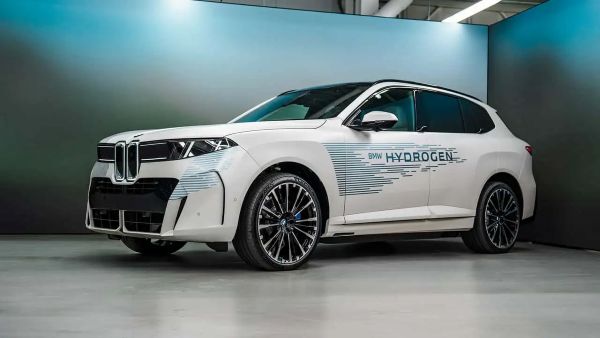
[DigitalToday intern reporter Seung-a Yoo] BMW will launch the hydrogen fuel cell SUV iX5 Hydrogen in 2028.
InsideEVs, an electric-vehicle-focused outlet, reported on Monday that BMW recently unveiled the fifth-generation X5 and presented plans for five powertrains: gasoline and diesel hybrids, plug-in hybrids (PHEVs), fully electric vehicles (EVs) and a hydrogen-powered model. It has not yet disclosed the countries where the hydrogen model will be sold.
The announcement came as hydrogen vehicles remain confined to a limited market. While fast-charging networks for EVs are expanding and supply chains are maturing quickly, hydrogen vehicles are struggling to broaden sales due to a lack of refuelling stations and high costs. The U.S. Department of Energy said all 47 public hydrogen refuelling stations in the United States are in California. As of last year, more than 80 percent of the world’s hydrogen refuelling stations were concentrated in five countries: China, Japan, South Korea, France and Germany.
BMW sees hydrogen not as a standalone automotive technology but as an axis linked to energy storage infrastructure. Philip Koehn (필립 쾬), head of vehicle lines at BMW Group, said at the X5 unveiling event that if a hydrogen economy becomes reality, it is likely to happen alongside an expansion of renewable energy. He said hydrogen can "store vast amounts of energy."
BMW’s logic is focused on changes to power grids. As wind and solar generation increases, more means are needed to store surplus electricity, and hydrogen could be an alternative in addition to batteries. The idea is to use surplus electricity to produce hydrogen through electrolysis, store it, and later convert it back into electricity for vehicles, cargo and industrial equipment. BMW believes that as such storage demand grows, hydrogen refuelling infrastructure for vehicles will follow.
Details of the iX5 Hydrogen were also disclosed. The vehicle carries 7 cylinders that store 7 kg of hydrogen. The fuel cell combines stored hydrogen with oxygen in the air to generate electricity, which drives the motor. The fuel-cell powertrain was jointly developed with Toyota. BMW said the vehicle can travel up to 750 km on the WLTP cycle and can be refuelled in under 5 minutes. It also said the model will be the first four-wheel-drive passenger car powered by hydrogen.
The issues are economics and infrastructure. Hydrogen fuel cell vehicles promote fast refuelling as an advantage similar to EVs, but the price has not yet been disclosed. Unlike EVs, which are narrowing the price gap with internal combustion vehicles, hydrogen fuel cell vehicles remain far more expensive. Limited refuelling locations are also a major obstacle to commercialisation.
A dispute over environmental impact also remains. The U.S. Department of Energy said 95 percent of hydrogen produced in the United States is currently based on fossil fuels. Expanding so-called green hydrogen made with solar and wind power would be needed to strengthen the environmental credentials of hydrogen vehicles.
Hydrogen and batteries also play different roles as energy storage. Research results suggest hydrogen is more likely to complement batteries than compete directly. Batteries are strong at quickly absorbing fluctuations in power grids, while hydrogen has very low self-discharge and can be stored for months. But the round-trip efficiency of converting electricity to hydrogen and back is only 35 to 55 percent, lower than the 80 to 90 percent of battery storage systems.
Despite these limitations, BMW is not halting hydrogen technology development. BMW has operated hundreds of hydrogen forklifts and trolley trains for more than 10 years at its Spartanburg plant. Hyundai Motor Group is also using the hydrogen fuel cell heavy-duty truck Xcient for short-distance transport at its Georgia plant. Toyota’s Mirai, Honda’s CR-V e:FCEV and Hyundai’s Nexo are also being sold, but results are limited. Mirai sales in the United States totalled just 210 units last year.
BMW stressed that the driving feel of its hydrogen SUV will be no different from a battery electric vehicle. Like its battery electric sibling model, the iX5 Hydrogen shares the Heart of Joy computer and sixth-generation (Gen6) high-voltage battery architecture.
Ultimately, BMW’s hydrogen vehicle strategy depends less on boosting short-term sales than on whether a long-term energy storage ecosystem actually grows. Whether hydrogen expands infrastructure on the back of power-grid storage demand or remains a costly experiment is expected to be tested in the market after the iX5 Hydrogen launch in 2028.
 Seung-a Yoo
ysah@d-today.co.kr
Seung-a Yoo
ysah@d-today.co.kr