
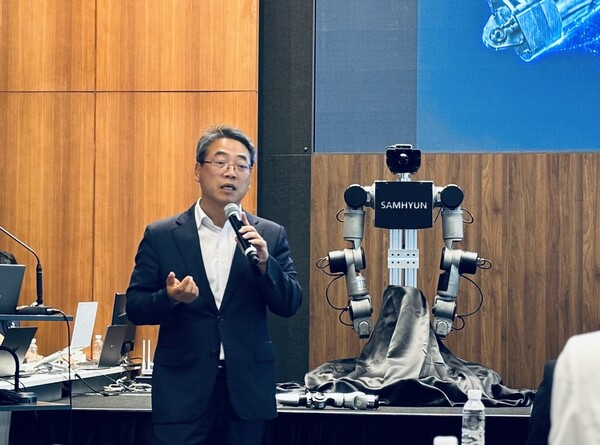
[DigitalToday reporter Seok Dae-geon] Motion-control specialist Samhyun plans to invest a total of 100 billion won, including 40 billion won in a humanoid robot actuator business, through 2029 as it moves to shift its business. It has secured 21 prospective customers in the order-taking stage on the back of what it said is the country’s first full lineup of joint actuators that integrate a motor, reducer and controller. It has already signed overseas mass-production contracts with 2 of them, it said.
Samhyun on Tuesday held its "Marketing Communication Day 2026" and unveiled for the first time its proprietary brand, "AXLON." It uses an X-in-1 structure that integrates a motor, reducer, controller and sensor into a single unit from the design stage. The lineup comprises 12 models: the I series for major rotary joints in robots (5 harmonic types and 5 planetary types), the O series that maintains back-drivability even under strong impacts, and the linear-type L series used for high-load lower-body joints. Samhyun said it analysed requirements from about 100 customers within 1 year of starting actuator development and distilled them into five core indicators: lighter weight, higher efficiency, torque density, precision control and low noise.
Samhyun said current industry actuator torque density remains at around 50 to 70. If it exceeds 100, parts can be made smaller while reducing battery consumption, significantly increasing design flexibility for finished products, it said. Samhyun said it implemented a level close to its target of 100 in AXLON and has already begun advance development aiming to exceed 100 in a second-generation product planned for release next year.
Samhyun said it manages the order process in four stages: prospect (start of discussions), assess (evaluation), spec-in (specification confirmation) and order. Among the 21 customers currently in the order pipeline, development talks are under way simultaneously for 7 actuator types, 26 motor types and 3 controller types. With 1 domestic customer, it has already entered the mass-production prototype stage, it said.
Its investment plan has also been detailed. Samhyun will invest a total of 100 billion won from 2025 to 2029, allocating 40 billion won of that to humanoid actuators. It completed investment in controllers in September last year and now has annual production capacity of 500,000 units. It plans to expand motor capacity sequentially from 500,000 units in phase 1 to 1,000,000 units in phase 2. Large-scale line investment is also planned for reducers, and a second plant completed last month will support an autonomous manufacturing (AX) factory as a robot-dedicated production base.
◆Widening the gap with rivals through in-house motor and controller technology
Samhyun said motors using a segmented core method delay heat generation by 58 percent compared with rivals and reduce cogging torque by 75 percent. It said lower cogging torque reduces operating noise and vibration and is advantageous for precision control.
In controllers, it applied for the first time domestically the automotive safety standard A-SPICE C-Level 2 and supports three control modes — impedance, position and torque — enabling customised responses to customer requirements. It said it is the only domestic company that can design in-house all three reducer methods — planetary, harmonic and cycloid — and cited its possession of Romax, an expensive analysis tool, as a basis for design reliability.
Samhyun forecast that humanoid sales will reach 30 million units in 2030. With 20 to 30 actuators needed per unit and a per-unit actuator price of about 1 million won, the related market is expected to expand rapidly. Samhyun forecast that volume will remain at 40,000 to 60,000 units — a level it described as mass sampling — through this year, then rise in 80,000-unit increments from next year, with 2028 marking entry into a full-fledged growth phase.
On why it is focusing on supplying parts rather than entering finished products, Samhyun stressed a principle that it must be able to flexibly supply products and parts that customers want. It also said it is selling not only actuators but also individual components such as motors, reducers and controllers.
It is also shifting its business structure. Samhyun said its operating profit margin is in the 5 percent range in mobility, compared with about 15 percent in defence, and it expects the robot segment to be higher than that. It forecast that sales in new businesses such as defence and robots will surpass existing mobility sales in 2028, and that its business structure will be reshaped around robots in 2030. Its order backlog excluding robots stands at 1.3 trillion won, and it is expanding its defence business into areas including power generation systems (APU), launch systems (APS) and maintenance (MRO).
Samhyun CEO Park Ki-won (박기원) said, "Samhyun is a company with the infrastructure and capital strength to actually conduct mass production." He added, "Large-scale equipment investment centred on Shinjuk Plants 2 and 3 is Samhyun’s unique competitiveness that can immediately absorb customer orders." Park said, "Mobility drive technology assets and precision control know-how accumulated over about 30 years formed the foundation of this AXLON development."
 Seok Dae-geon
d2dg@d-today.co.kr
Seok Dae-geon
d2dg@d-today.co.kr