
With the spread of AI increasing cyber threats, there was a proposal that information security systems should shift toward automation and self-reliant capabilities. As AI itself emerges as a new attack surface, defense technologies and governance should also be redesigned for the AI era.
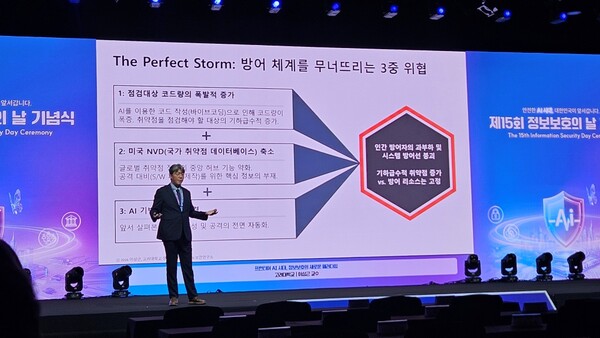
Sang-geun Lee (이상근), a professor at Korea University, said in a keynote speech at the 15th Information Security Day ceremony held at the Shilla Hotel in Seoul on July 8, "We must assume a situation in 2028 where hacking becomes routine and attacks occur minute by minute." He said, "The defense-automation gap will create differences in response capabilities between companies and institutions."
◆ "AI itself is a new attack surface...we must secure our own defense capabilities"
Lee likened the recent cyber threat environment to a "perfect storm." As generative AI-based development culture such as vibe coding spreads, code output surges, and software bugs and vulnerabilities increase in the process, he said. He also assessed that cases are increasing in which attacks happen before vulnerabilities are officially disclosed, and that generative AI can be abused for cyber threats.
He said AI itself has become something that needs to be protected. Prompt injection, training data poisoning attacks, model copying and extraction, and supply-chain and integrity threats have emerged as new attack surfaces in the AI era. From an attacker’s perspective, reconnaissance and vulnerability analysis, attack-code generation and even execution can be automated with AI, he said, adding that existing defense systems have limitations.
Lee presented AI-based automatic generation of vulnerability patches and automated deployment, building an intelligent network monitoring system, and establishing an AI governance framework as response directions. He also stressed the importance of securing in-house capabilities that are not dependent on specific models and high token costs, along with systems that automatically generate patches using frontier models or agentic systems.
He also proposed that endpoint defense and network monitoring should shift to a model in which AI responds to AI attacks. In a situation where attackers attempt attacks in automated ways, defenders also need automated systems from threat detection and response through patch application, he said.
Lee said, "It is important to innovate processes before a security incident occurs," adding, "We need independent AI defense technology, network defense systems and training of key AI security talent."
AI-based defense automation was also a key agenda at a cybersecurity development seminar. Ho-won Kim (김호원), president of the Korea Institute of Information Security and Cryptology, said, "If large-scale code and system knowledge are learned by frontier-level general-purpose LLMs, and multi-stage attack chain generation and verification can be carried out, then detecting security vulnerabilities is possible."
Kim said an optimal autonomous detection system can be designed through an agent-orchestration structure that organically controls various AIs, rather than relying on a single hyperscale model.
◆ "Even non-hackers can easily attempt hacking...AI seat belts are needed"
Doo-sik Yoon (윤두식), CEO of Iroun&Company, compared AI safety to a car seat belt in a keynote speech. He argued that standards and mechanisms should be put in place first so AI can be used properly.
Yoon said AI can be exposed to attacks in various ways, including prompt injection, abuse of autonomous agents and deepfakes. He said, "By combining open-source tools and AI coding tools, an environment is being created in which even those who are not professional hackers can attempt attacks targeting companies and individuals."
He presented visibility, defense, isolation, accountability and trust as key elements for AI security. In the process of using AI, it should be possible to see what information comes in and goes out. He said input and output guardrails, jailbreak and injection defenses, output validation, control of agent behavior and verification of agent identity are also needed. He added that a system that logs actions performed by AI is also important for analyzing the cause of incidents.
Overseas AI threat defense systems were also shared. The U.S. Cybersecurity and Infrastructure Security Agency (CISA), the UK AI Safety Institute and Google participated in keynote speeches. Nick Anderson, acting director of CISA, said, "Various threat actors are targeting national critical infrastructure," adding, "We must manage AI so it does not become a tool that amplifies threats from hostile forces."
He stressed that international cooperation is important to pursue AI innovation and security in parallel. He said consistent joint response systems can be created by sharing innovation cases through cooperation with allies such as South Korea. He also emphasized a stance in which the international community shares responsibility so new technologies such as AI are used to protect people and strengthen capabilities.
◆ AI special exhibition hall set up...awards for security contributors
The event was held under the theme, "A safe AI era, South Korea leads the way," hosted by the Ministry of Science and ICT, the National Intelligence Service and the Ministry of the Interior and Safety together with the Korea Internet & Security Agency (KISA), the Korea Information Security Industry Association and others. This year marked the first time South Korea’s three mobile carriers participated together. SK Telecom and KT also met visitors through an AI special exhibition hall.
At the ceremony, awards were presented to a total of 35 people for contributions to information security, a public representative group delivered a message of hope for a safe AI era, and an exhibition of outstanding AI-based information security products was held. At the awards ceremony, Jin-yeon Lee (이동범), CEO of Genians, received the Order of Civil Merit, Pomegranate Medal. Yong-dae Kim (김용대), a professor at KAIST, received the Presidential Commendation, and Jae-cheol Ha (하재철), a professor at Hoseo University, received the Service Merit Medal.
Je-myung Ryu (류제명), second vice minister of the Ministry of Science and ICT, said, "We will actively use AI in tracking and detecting cyber threats and focus on proactive prevention and swift response," adding, "I hope today’s event will serve as an opportunity to firmly strengthen South Korea’s digital trust."
President Jae-myung Lee (이재명) said in a congratulatory address read on his behalf, "As AI rapidly spreads throughout our society, the importance of information security is growing more than ever," adding, "We will expand an all-ministry cooperation system to respond quickly to new threats and actively foster AI-based security technology and the industrial ecosystem."
 Jin-ho Lee
jhlee26@d-today.co.kr
Jin-ho Lee
jhlee26@d-today.co.kr