
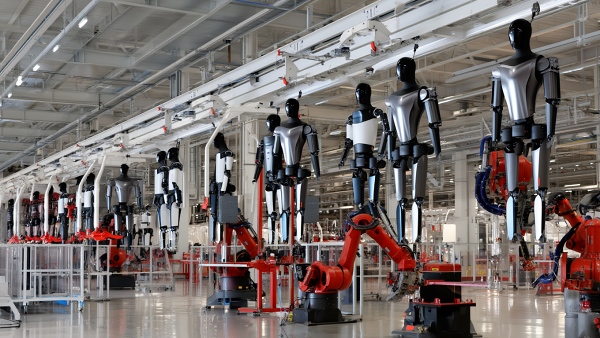
An engineer who took part in developing Tesla's humanoid robot Optimus has founded a new humanoid robotics startup in Europe, challenging Tesla, Figure and Chinese companies. The company plans to begin industrial field trials this year with a general-purpose artificial intelligence (AI) humanoid robot targeting Europe's manufacturing and logistics markets. EV outlet Electrek reported the details on July 7 (local time).
Former Tesla engineer Remi Cadene (레미 카덴) unveiled plans to develop a next-generation humanoid robot called Northstar as co-founder and chief executive of Paris-based humanoid startup UMA. The company is discussing potential adoption with about 50 prospective customers and aims to start an industrial pilot programme this year.
UMA is targeting manufacturing plants and logistics warehouses as its main market and plans to expand its business into home-use humanoids over the longer term. It has presented a strategy of prioritising Europe over the United States or China.
Cadene forecast that demand for humanoids would rise quickly because Europe faces structural problems including high labour costs, labour shortages and ageing populations. "Europe has very high labour costs, and considering the demographic structure, demand for automation will increase significantly," he explained.
The founding team is made up of robotics and AI specialists. Co-founders include former Hugging Face engineer Simon Alibert (시몽 알리베르) and robot designer Rob Knight (롭 나이트). Investors include Greycroft, Relentless and Unity Growth, and Meta's chief AI scientist Yann LeCun, Datadog CEO Olivier Pomel and Hugging Face co-founder Thomas Wolf also joined as individual investors.
Cadene's track record is cited as UMA's biggest strength. He spent about 3 years in Tesla's Autopilot organisation, working on driver-assistance systems and Optimus AI. He later moved to Hugging Face and led development of the open-source robotics library LeRobot, which grew into a leading open-source robotics project by securing more than 12,000 GitHub stars within a year of its release.
Competition in the market is intense. The humanoid market is currently led by U.S. companies such as Tesla and Figure, and Chinese companies including Unitree. Tesla plans to start limited production of the third-generation Optimus at its Fremont, California factory this summer, but has not disclosed a commercialisation case for external customers. Elon Musk (일론 머스크), Tesla's CEO, also acknowledged earlier this year that Optimus is doing some tasks inside the company but is not yet at the stage of full productivity.
In terms of real-world deployment, Figure is cited as being ahead. Figure is being put to work on actual production-line tasks at BMW's plant in Spartanburg, South Carolina, moving a step ahead in commercialisation. Hyundai Motor and Boston Dynamics are also expanding development of industrial humanoids.
UMA has not shipped a finished product yet, but is preparing to enter the market by holding talks with companies considering actual adoption. Its first task is to turn pilot projects scheduled for this year into paid contracts.
Based on images released so far, there are also observations that UMA's hardware completeness appears to lag behind rivals. But the industry sees the core of humanoid competition as software and AI rather than mechanical structure. That is because a robot's ability to understand real spaces and perform tasks like a human will determine whether commercialisation succeeds.
UMA is seeking differentiation in this area by leveraging AI capabilities built at Tesla and Hugging Face. If pilot projects lead to commercial contracts, the possibility has been raised that an independent humanoid robotics company could grow in earnest in Europe as well.
 Jinju Hong
hongjj@d-today.co.kr
Jinju Hong
hongjj@d-today.co.kr