
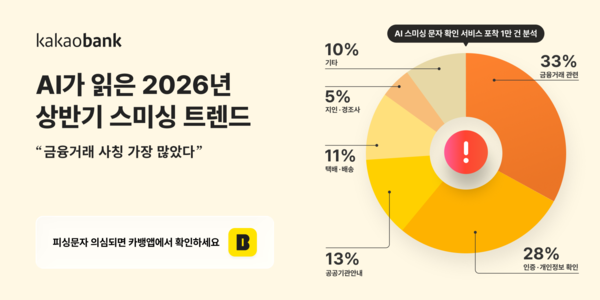
KakaoBank analysed that among suspected smishing texts received in the first half of this year, the largest share were cases masquerading as financial transaction notices. A growing number of messages deceive users into thinking a real financial transaction has occurred, such as payment approval, a refund or account verification, to prompt clicks or the input of personal information.
KakaoBank said on Tuesday that it analysed 10,024 suspected smishing texts submitted through its AI Smishing Text Check service from January to June, and found that financial transaction-related smishing accounted for the largest share at 33 percent.
By type, the breakdown was 33 percent financial transaction-related smishing, 28 percent authentication and personal information verification, 13 percent public institution notices, 11 percent parcel and delivery, 5 percent acquaintances and family events, and 10 percent other.
In financial transaction-related smishing, many cases used phrases such as "payment approval", "deposit", "refund" and "account verification" to entice users to access phishing sites or install malicious apps.
Compared with the previous year, smishing that induces immediate action by pretending a real financial transaction has occurred increased, it showed. The authentication and personal information verification category also maintained a high share, continuing from last year.
A KakaoBank official said, "Smishing methods are evolving as they quickly reflect social issues and users' daily lives." The official added, "If you receive a suspicious text, we hope you check it through the AI Smishing Text Check service before clicking the link."
 Ji-young Lee (이지영)
ljy@d-today.co.kr
Ji-young Lee (이지영)
ljy@d-today.co.kr