
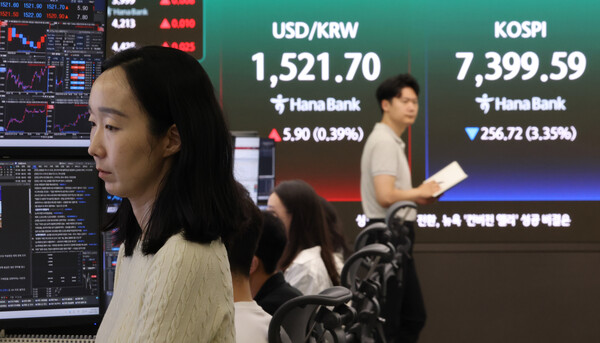
South Korea's KOSPI was down more than 2 percent in early trading. After Samsung Electronics' earnings announcement, volatility in domestic semiconductor shares appeared to spread to U.S. markets, bringing renewed concerns about a correction in the chip industry.
As of 9:12 a.m. on July 8, the KOSPI was down 173.61 points, or 2.27 percent, from the previous session at 7,482.70.
The index opened down 203.83 points, or 2.66 percent, at 7,452.48. It rose as high as 7,522.27 during the session, but fell to a low of 7,352.89.
In the main KOSPI market, individuals and institutions were net buyers of 12.7 billion won and 190.7 billion won, respectively. Foreign investors were net sellers of 197.2 billion won.
Most top stocks by market capitalisation were weaker. Samsung Electronics was down 5,500 won, or 1.86 percent, at 290,500 won. SK Hynix was down 9,500 won, or 0.43 percent, at 2,191,500 won.
SK Square fell 6.49 percent, Samsung Electro-Mechanics fell 6.49 percent, Hyundai Motor fell 2.61 percent, LG Energy Solution fell 3.46 percent, Samsung Life fell 6.80 percent, Samsung C&T fell 5.42 percent and Samsung Biologics fell 1.90 percent.
The KOSDAQ was also weaker. At the same time, the KOSDAQ was down 19.49 points, or 2.34 percent, at 811.74.
In early trading, the won was at 1,519.80 per dollar, up 2.60 won, or 0.17 percent, from the previous session.
A correction in semiconductor shares also continued in the U.S. market. After Samsung Electronics released preliminary second-quarter results, the fallout from a sharp drop in Asian semiconductor shares spread to U.S. chip stocks, and the Philadelphia Semiconductor Index also fell.
Some in the brokerage industry also say it is too early to conclude that the artificial intelligence investment cycle has ended or that the memory sector has already passed an early peak.
Han Ji-young (한지영), a researcher at Kiwoom Securities, analysed that the index is likely to try to rebound during the session as factors such as the earlier pricing-in of a sharp drop in U.S. chip stocks, a narrowing of losses late in the session, and inflows of bargain buying following a series of sharp declines since July add resilience to the index.
 Sangyeop Oh
yub@d-today.co.kr
Sangyeop Oh
yub@d-today.co.kr