
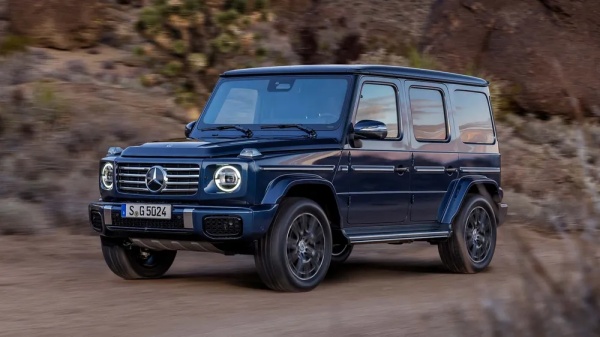
[DigitalToday reporter Jinju Hong] Mercedes-Benz is reported to be pursuing a plan to set the production site for its compact G-Class, the so-called “Baby G”, in Hungary rather than Germany. The strategy aims to lower production costs to offer a G-Class at a more accessible price point. It is also drawing attention as it ties in with introducing a next-generation platform that supports both electric vehicles and internal combustion engines.
InsideEVs, an electric-vehicle outlet, reported on July 6 that Mercedes-Benz is seriously considering a new plant in Kecskemet, Hungary, as the production base for the Baby G. The G-Class has been a flagship luxury SUV produced in Germany, but it has been suggested the compact model could take a different production approach to secure cost competitiveness.
The biggest driver is cutting manufacturing costs. Mercedes has previously set out plans to reduce production costs by 10 percent from 2024 to 2027, and to double the scale of the cuts by 2030. Using Hungary, where labor costs are relatively lower, as a production hub is seen as a way to secure cost competitiveness while keeping a premium brand image.
The Baby G was initially reported to be developed as a pure battery-electric model, but it is now said to have shifted toward the next-generation MMA (Mercedes Modular Architecture) platform that supports both electric and internal combustion powertrains. Mercedes has already built an MMA-based vehicle production system at plants in Rastatt, Germany, and Kecskemet, Hungary. Earlier this year it also announced plans to move A-Class production from Germany to Hungary. This has led to analysis that the Baby G is also likely to follow the same direction as its existing production strategy.
Even if production costs fall, it is unlikely the vehicle’s price will drop sharply. The company is expected to keep the premium image of the G-Class brand while positioning the model as a luxury SUV with a relatively lower burden than the existing G-Class.
The vehicle’s character is also expected to differ from the existing G-Class. The exterior is expected to carry over the traditional G-Class design, but its off-road performance is likely to fall short of the large G-Class.
The MMA platform is an architecture designed primarily with on-road driving in mind. That makes it unlikely to be easy to replicate military-vehicle-level rough-terrain capability or strong off-road performance as-is.
Mercedes plans to maintain a certain level of off-road capability. It has been suggested the model could get higher ground clearance and an improved suspension structure than the electric crossover GLB EV. However, the drivetrain is expected to adopt a more general dual-motor setup or a front-based all-wheel-drive system, rather than using four motors as in the existing G-Class electric vehicle. For hybrid models, it has been suggested a Haldex-type AWD system that sends power to the rear wheels when slippage occurs could be applied.
Some in the industry also say Mercedes’ strategy reflects actual consumer buying patterns. Most G-Class buyers choose the vehicle for its design, brand value and luxury image rather than extreme off-road use, and the compact model is therefore likely to establish itself as a lifestyle-focused premium SUV.
The Baby G is expected to be a model that tests three challenges at once for Mercedes: a dual-track strategy for electric and internal combustion vehicles, a reorganization of European production bases, and an expansion of the G-Class brand. The market’s main focus is emerging as the final production site, the powertrain lineup, and how much of the G-Class’ distinct identity it will retain.
 Jinju Hong
hongjj@d-today.co.kr
Jinju Hong
hongjj@d-today.co.kr