
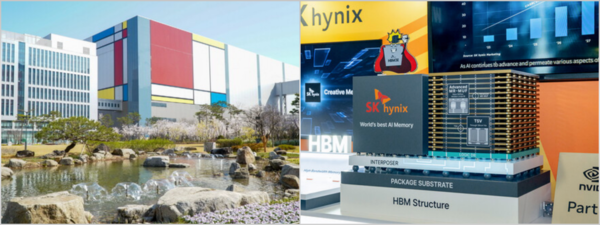
The semiconductor industry’s in-house talent pipeline is weakening. Repeated job moves known as “Ha-Sam-Ha” — from SK Hynix to Samsung Electronics and back to SK Hynix — or the reverse “Sam-Ha-Sam” are driving the shift. Concerns are also growing that process know-how built by both companies could mix as people move, weakening the originality of K-semiconductor technology.
A series of developments, including SK Hynix repeatedly conducting experienced-hire recruitment and a spotlight on performance bonus gaps between the two companies, is changing patterns of workforce movement in the semiconductor industry. In the past, moving from SK Hynix to Samsung Electronics was common. That direction has reversed as SK Hynix’s standing has risen on the back of HBM. Industry officials say Samsung Electronics engineers with doctorate backgrounds have applied to SK Hynix’s experienced-hire recruitment aimed at workers with fewer years of experience. They also say some Samsung Electronics talent that had been heading to overseas companies has changed course and is seeking jobs at SK Hynix.
It is not only about incoming hires. Many are also returning to SK Hynix. According to the industry, SK Hynix is selectively taking return applicants by business division because the number of applicants far exceeds its hiring scale. It is reported to have set a direction of generally not hiring unless the candidate is outstanding. Engineers appear to be adopting a pragmatic approach of moving between the two companies to raise their market value.
The opposite flow is also being detected. As Samsung Electronics tries to win back departing staff through investment and improved treatment, the “Sam-Ha-Sam” path — moving to SK Hynix and then returning to Samsung Electronics — is also being discussed in the industry.
There is also a view that legal constraints that had applied to such back-and-forth moves have eased. In January, the Seoul Central District Court’s Civil Division 60, presided over by Judge Mi-kyung Kim (김미경), rejected SK Hynix’s request for an injunction to ban a former employee, identified as A, from joining a competitor after he moved to Samsung Electronics. SK Hynix did not appeal, and the decision was finalised.
A joined SK Hynix in 2013 and was selected as key talent around 2022. He served as a team leader in an HBM design unit. When he resigned in April 2024, he signed a two-year non-compete agreement. After working as an invited researcher at KAIST and a researcher at a Samsung Electronics affiliate, he has worked since April 2025 as an executive in Samsung Electronics’ Standard HBM Group, in charge of chip integration design.
SK Hynix argued that A’s HBM and DRAM design technology falls under national core technology. It also said a two-year non-compete was not excessive given the HBM3 and HBM3E technology gap and market share gap between the two companies. The first-instance court did not accept the claim. The court said restricting freedom of occupational choice requires compensation sufficient to offset the employee’s loss, but A did not receive explicit consideration. It also found it difficult to say he had worked long-term in an important position because his appointment as team leader was close to his resignation.
The court said it was difficult to view the circumstances of his resignation as strongly disloyal. It also said it was hard to conclude that Samsung Electronics could narrow the technology gap based only on a job move one year after resignation. The Supreme Court has also ruled that freedom of occupational choice and the right to work are fundamental rights, and non-compete agreements are valid only within the scope recognised as a reasonable restriction.
◆ Pragmatic engineers take hold as bloodline hiring breaks down
The issue is that know-how can move even without leaks in document form. Critics point out that in semiconductor processes, trade secrets accumulated through trial and error by field engineers carry more weight than technologies disclosed through patents. Frequent movement of semiconductor workers is also an industry-wide phenomenon.
A Korea Employment Information Service report says it is common for engineers and research and development staff to build 2 to 3 years of experience and then use it as a springboard to move in pursuit of higher pay. Observers say if such moves are repeated among large companies, process optimisation values stored in people’s minds could be shared in real time. They also say a homogenisation could emerge, with the two companies’ proprietary architectures coming to resemble each other.
The government has also significantly expanded its organisation to respond to technology leaks, underscoring such concerns. The Korea Intellectual Property Office announced on June 29 a plan to expand and reorganise its response system against technology leaks and theft, and began operating it from June 30. It created a special judicial police division dedicated to the leakage of trade secrets and national core technologies and increased investigative staff to 61 from 27. The organisation was expanded to a four-division system from a single division.
As courts have reined in non-compete agreements without compensation, there is a view that the two companies need to overhaul institutional rewards to retain key talent. An industry official said, “It is difficult to stop job moves themselves,” adding, “Securing semiconductor talent is also a way to protect proprietary know-how.”
 Daegeon Seok
d2dg@d-today.co.kr
Daegeon Seok
d2dg@d-today.co.kr