
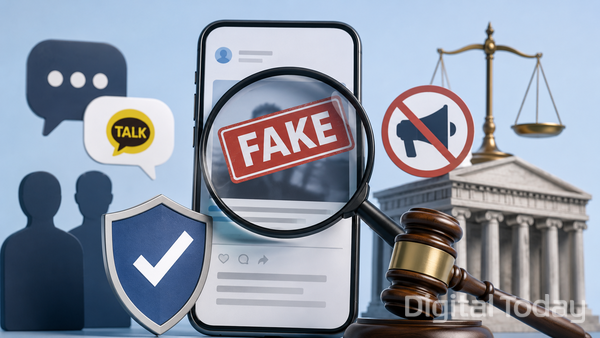
The Broadcast Media Communications Commission said on Tuesday that a partial revision to the enforcement decree of the Act on Promotion of Information and Communications Network Utilization and Information Protection aimed at preventing the spread of illegal and false manipulated information passed a cabinet meeting.
The revision is a follow-up measure needed to implement the Information and Communications Network Act that was revised and promulgated in January. It specifies the scope of large information and communications service providers and the criteria for posters subject to claims for punitive damages.
The enforcement decree defines large information and communications service providers as businesses that run information intermediary services between users, such as social networking services and online communities, with at least 1 million daily average users over the previous three months as of the end of the prior year. Those businesses must establish self-regulatory policies containing criteria for determining illegal and false manipulated information and procedures for reporting and action, and must publish transparency reports.
It set posters eligible to be targeted for claims for punitive damages as those who posted information at least 3 times in total over the previous three months and earned revenue such as advertising, and who have at least 100,000 subscribers or at least 100,000 average monthly views over the previous three months.
It also set the scope of public figures subject to disclosure obligations along with dismissal of lawsuits when claims for punitive damages are abused. They include election candidates, heads of public institutions, public officials subject to asset disclosure, individuals subject to confirmation hearings, party leaders, heads of media companies, and the same persons of business groups subject to disclosure and their affiliated representative directors and largest shareholders.
For reporting illegal and false manipulated information, it required the report to include the specific location of the content being reported, the reason it is judged to be illegal and false manipulated information, supporting materials, and the reporter’s contact information and name.
It also established standards for supporting fact-checking organisations. The commission plans to designate the principles code of the International Fact-Checking Network as a public notice, as a norm that meets internationally accepted fact-checking principles and standards of neutrality, fairness, transparency and accountability. It also specified the content of agreements between large service providers and fact-checking organisations and how fact-checking organisations should disclose reports.
It specified the work of the Transparency Center, which is in charge of overseeing large service providers and supporting fact-checking organisations.
Fines will be imposed when a person who makes a business of delivering facts or opinions to an unspecified number of people through information and communications networks distributes illegal and false manipulated information confirmed by a court ruling at least 2 times. The measure applies when, at the time of distribution, the person posted at least 3 items in total over the previous three months and earned revenue such as advertising. Authorities can impose up to 1 billion won. The amount will be set by applying mandatory increases and additional increases or reductions to a base amount depending on the severity of the violation, and detailed standards will be set by the commission’s public notice.
Administrative fines will be imposed if a party fails without just cause to respond to a request for information from the mediation panel under the Broadcast Media Communications Review Commission. The amount is 3,000,000 won for a first violation, 6,000,000 won for a second violation and 10,000,000 won for a third or subsequent violation.
Kim Jong-cheol (김종철), chair of the Broadcast Media Communications Commission, said, "This revision is to faithfully implement the intent of the higher-level law revision prepared to protect the public from the harm of illegal and false manipulated information." He added, "We will strive so that the constitutional values of freedom of expression and maintaining community order can be balanced online."
 Seul-gi Son
sageson@d-today.co.kr
Seul-gi Son
sageson@d-today.co.kr