
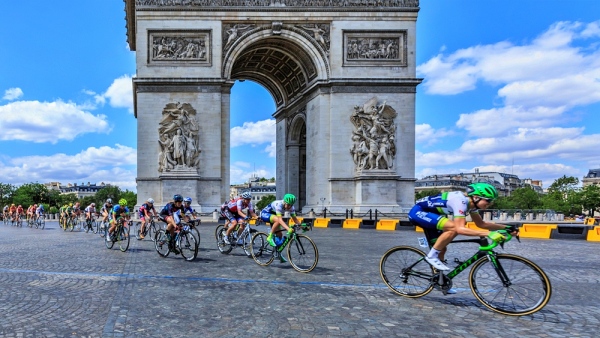
The Tour de France, a global cycling race with a 100-year history, opens on July 4 (local time) in Barcelona, Spain, in extreme heat. With Spain and France continuing to see high temperatures after Europe experienced record heat in June, the world’s biggest cycling event has moved to prepare measures to protect riders.
On July 3 (local time), foreign media outlets including BikeRadar reported that temperatures in Barcelona on the opening day are expected to rise to 33 degrees. In Stage 4 on July 7 from Carcassonne to Foix, temperatures are expected to approach 40 degrees, and Stage 5 is also expected to bring heat of 30 degrees.
Tour de France organiser Christian Prudhomme (크리스티앙 프뤼돔) told AFP in an interview, "It is obvious that high temperatures are expected during the race. Protecting riders and spectators is the top priority, and the key is responding in line with the situation." He referred to the Union Cycliste Internationale (UCI) heat protocol introduced for the 2024 season. The protocol assesses risk by combining temperature, humidity, wind speed and riding speed, and in the highest risk stage above 28 degrees (red zone), it allows changes to race times and even suspension or cancellation.
Prudhomme told French media outlet L'Equipe in an interview, "We also deployed additional cooling motorcycles and requested additional ice," adding, "We are in continuous communication with the UCI and riders and team representatives."
Prudhomme said riders are somewhat used to heat as they already experienced temperatures of 42 degrees in January at the Tour Down Under. But concerns remain after a recent case in the final stage of the Tour de Suisse in which rider Elisa Balsamo lost 10 minutes due to heatstroke.
Bignen Fernandez (비뉴앙 페르난데스), sports director of the Cofidis team, told Britain's BikeRadar at the Barcelona start ceremony that the team plans to use ice packs before and after stages to lower riders’ body temperatures. "It is the only way we can do it in this situation," he said. "We are burning fossil fuels and creating this problem ourselves. Cooling the body is important, but we also need to cool the Earth," he added.
The Tour de France has continued for more than 100 years since its first race in 1903. Early editions had far fewer stages than today, but the distances were longer. The 1903 race had just 6 stages, with an average distance of 404 km per stage. The 1926 race, with 17 stages and a total distance of 5,745 km, recorded the longest distance in the event’s history.
This year’s race starts in Barcelona and runs to Paris over 21 stages and a total of 3,333 km. Compared with the early years, the number of stages has increased while the total distance has shortened. In the past, the next stage began immediately where the previous one ended, but in recent years the format has changed to cover more varied regions with travel between cities.
 Hyunwoo Choo
cookinpapa@d-today.co.kr
Hyunwoo Choo
cookinpapa@d-today.co.kr