
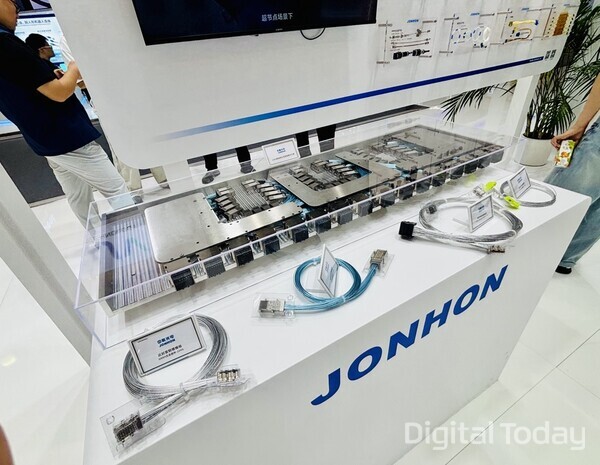
Electronica Shanghai 2026, held at the Shanghai New International Expo Centre (SNIEC) from July 1 to 3, drew 2,065 companies. That was up 271 companies, or 15.1 percent, from 1,794 a year earlier, and exhibition space expanded 20 percent to 120,000 square metres from 100,000 square metres. From connectors to power semiconductors and sensors, Chinese local companies rolled out new products in categories long regarded as the preserve of global firms.
According to an Electronica Shanghai official, this year’s exhibition covered the full ecosystem of core sectors including semiconductors, sensors, power management and connectors. It centred on 10 trend areas including intelligent new-energy vehicles, artificial intelligence (AI), embedded intelligence, AI data centres, green energy storage and 6G communications. The show was structured to target application industries broadly rather than individual components, showing a shift in the centre of gravity in China’s electronics industry.
The most visible surge by Chinese companies was in the connector zone of Hall W. At the JONHON booth, a sheet-type high-current connector called EVH6 was displayed. It uses a multipoint contact structure to control heat at the source during high-current transmission while reducing weight by up to 20 percent. It is a component linking a battery pack and a high-voltage power distribution unit (PDU). Nearby, Recodeal introduced a 12-pin connector for battery swapping that uses a multidimensional floating structure to absorb X, Y and Z axis positional deviation and maintain contact resistance even after tens of thousands of connections.
Yihua’s QSFP-DD and OSFP high-speed module with an integrated heat sink targets demand from AI servers. China’s industry assessed that the product achieved low-latency performance in high-speed transmission environments of 10 Gbps or more. ECT’s Mini-FAKRA connector reduces size by nearly 80 percent versus existing products and directly connects uncompressed ultra-high-definition camera data with 20 GHz transmission. ECT is seen locally as a leading maker of high-frequency, high-speed connectors and supplies automakers such as BYD. It overlaps head-on with the high-voltage, high-speed transmission area led by TE Connectivity and Rosenberger.
The trend seen in components extended to the semiconductor zone. At the GigaDevice booth, a six-axis robot arm equipped with the GD32H7 MCU for robot joints drew visitors as it demonstrated high-precision position feedback. The chip, with a 750 MHz core and built-in EtherCAT communications, targets the embedded intelligence market.
WeEn also nailed down its roadmap at the event. It formalised the launch of a 2,000-volt rectifier for 1,000-volt-class charging infrastructure, and announced plans to roll out a 2,500-volt product in the second half of this year and expand its 2,200-volt silicon carbide (SiC) MOSFET lineup. Novosense’s CAN-FD-based integrated thermal management controller was cited as an example showing this year’s exhibition trend of moving “from standalone chip performance to system integration”, and SmartSens’s 140 dB dynamic range automotive image sensor added to the list as Chinese companies made their names on the global stage across sensors, power and control semiconductors.
Passive components are still “third-tier”...a last chance and warning for South Korea
Policy and domestic demand underpin the growth of China’s local companies. The Chinese government has rolled out multiple industrial policies while pushing a national action plan to raise the localisation rate of core components and materials to 70 percent by 2025. Demand also supports it. In 2025, Chinese automakers sold about 27 million vehicles worldwide, surpassing Japan for the first time. According to China’s industrial research firm EO Intelligence, the adoption rate of AI-based intelligent electric vehicles in China was close to 20 percent in 2025 and is expected to exceed 50 percent by 2030. In this structure, policy drives supply while electrification and AI lift demand.
Still, the push has not been completed across all areas. Mainland China has many passive component makers, but most remain in the global third tier. Gaps in technology and market share remain compared with top Japanese and South Korean companies, and securing core technologies needed for advanced products is also cited as a task. The gap between volume offensives in general-purpose components and high-end technological capability is the current state of China’s components industry.
China’s push is shifting from a volume battle in general-purpose products to a technological battle in high-end products, but the growth gap shown by this exhibition stood out clearly. As seen in passive components, the technology barrier for high-reliability, premium products remains in place. The base hardware extending through power semiconductors, materials and connectors overlaps exactly with areas where South Korean industry has built competitiveness over a long period.
If China is completing its components push through the combination of policy and domestic demand, South Korea also has ample room to compete in the high-end area if corresponding support is provided. An Electronica Shanghai official said, “Our goal is to present a solid technology roadmap so that the entire industry can seize opportunities in an era of great transformation.” That opportunity is not only for Chinese companies. This is why the exhibition is a last warning and an opportunity for South Korean companies.
 Daegeon Seok
d2dg@d-today.co.kr
Daegeon Seok
d2dg@d-today.co.kr