
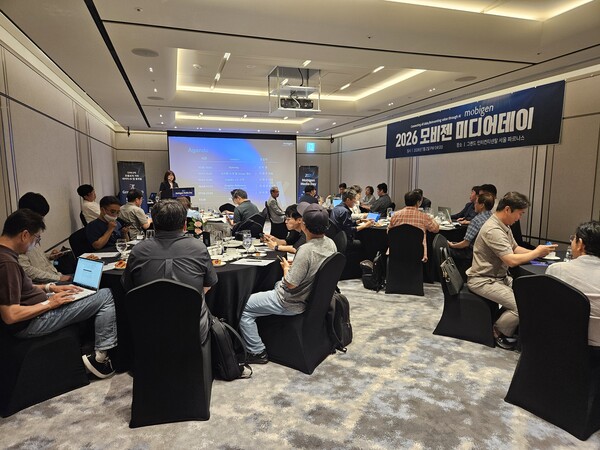
Mobigen, a data and AI specialist, held its '2026 Mobigen Media Day' on July 2. It stressed its push to become a data and AI specialist and unveiled Graphio 2.0, a dynamic ontology-based data and AI app platform.
The company said Graphio 2.0 is a dynamic ontology-based data and AI app platform that connects diverse data within a company into a single work environment and supports AI in understanding and using the data.
Graphio 2.0 advances the existing Graphio 1.0 Ontology Core by applying a Dynamic Ontology that responds on its own to changes in data and continues to evolve, it said.
The company stressed that this provides a new AI work environment that supports not only AI understanding data but also making decisions and executing based on work context.
Mobigen has selected four vertical AI business areas: defence, energy and plant engineering (EPC), AI operating systems (AIOS) and the public sector. It is expanding its business based on the Graphio product line.
Kim Tae-su (김태수), Mobigen's CEO, said competitiveness in the AI era depends not on AI models themselves but on how effectively AI can use data it can trust. He said Mobigen will continue to grow as a data and AI specialist supporting customers' AI innovation based on accumulated data technology and AI capabilities. Mobigen also stressed an AI strategy focused not on foundation models (FM) but on technologies that can generate synergies when combined with foundation models.
Kim said when ChatGPT emerged in 2022, many companies pursued development of proprietary models and there was also internal talk at Mobigen about building its own model. He said it decided to invest in technology that can combine with foundation models, and that technology is ontology. He said Mobigen launched Graphio 1.0 in 2025 and is now introducing Graphio 2.0. Based on this, he said Mobigen changed its vision and reorganised its organisation to become an AI company, and is converting research and development staff, who make up 80 percent of its workforce, into AI technology personnel.
According to Kim, ontology is a technology that teaches AI in advance how to read and interpret data. Kim said that if you throw a newspaper to a smart young child and ask for a stock prediction for the day, the child could analyse it to some extent but would find it difficult to reach an accurate conclusion. He said ontology tells which articles to look at and which articles to connect, and that it is highly effective when used within specific industry or corporate knowledge.
Graphio 2.0 has a four-layer structure: data, ontology, apps, and governance and collaboration. The key is the ontology layer, which connects scattered data and embeds context. The app layer supports linking large language models based on ontology and registering agents. Kim said there is no need to change the app layer even if the underlying data structure changes.
Hybrid retrieval-augmented generation (RAG) and dynamic ontology are also points Kim stressed about Graphio 2.0.
He said it integrated three types with ontology: structured RAG that processes structured data, vector RAG that processes documents, and graph RAG that processes knowledge relationships. He said it can infer by following relationships even if they are not explicitly written in documents.
He said the core of Graphio 2.0 is AI acting on its own based on a knowledge system built on dynamic ontology. He said if work policies are defined with ontology, it detects data changes and automatically executes workflows. Using bank suspicious transaction detection as an example, he said if real-time monitoring, criteria for judging suspicious transactions and subsequent actions are defined with ontology, AI can judge and execute on its own. He said it also provides a workflow tool that can deliver knowledge to AI and have it carry out tasks through on-screen settings without having to write code.
Mobigen will also release Graphio 3.0 in 2027. Kim said Graphio 3.0 focuses on connecting ontologies between different organisations. He said it will use federated ontology technology to enable federation and use at the ontology level only, without directly sharing data. He said it is a structure that enables AI collaboration between organisations while maintaining security. He said examples could include two banks linking suspicious transaction information in real time in response to voice phishing, or combining situational information from multiple agencies in defence to enable battlefield awareness.
 Chi-gyu Hwang
delight@d-today.co.kr
Chi-gyu Hwang
delight@d-today.co.kr