
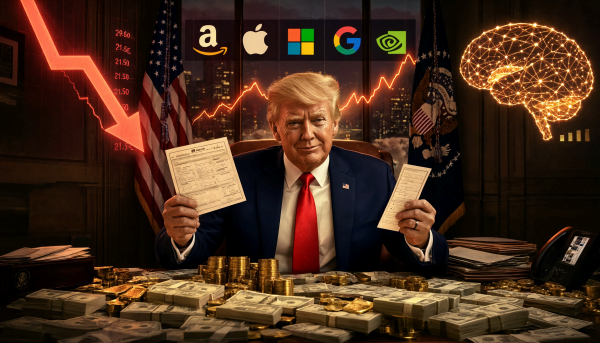
U.S. President Donald Trump was found to have bought large amounts of major tech stocks including Apple, Nvidia and Microsoft after a tariff shock sent markets sharply lower in April 2025.
That was the result of CNBC's analysis of his 2025 annual financial disclosure, published on July 2, local time.
According to the disclosure, Trump made 327 stock purchases on April 8, 2025 alone. That was the 11th-highest one-day total based on last year's 기준, and more than five times the annual daily average of about 62 trades. The buying coincided with a stretch in which stocks fell for four straight sessions after he unveiled broad, high-tariff plans on April 2 that year, calling it "Liberation Day."
The purchases focused on big tech. Trump bought between $100,001 and $250,000 worth each of Apple, Alphabet, Amazon, Microsoft and Nvidia that day. All are mega-cap tech stocks that are part of the "Magnificent 7." They had dropped sharply on worries about higher costs after the tariff announcement, but also rebounded quickly after the policy was partially rolled back.
On April 8, the S&P 500 closed below 5,000, nearing the threshold of a bear market, defined as a 20 percent drop from a recent peak. The cumulative decline over four sessions topped 12 percent. Early the next day, he posted on Truth Social that "now is a very good time to buy," and later that day said he would reverse some of the tariffs he had announced.
Markets then surged. The S&P 500 rose about 9.5 percent that day and gained about 50 percent cumulatively from April 8. Individual stocks also moved sharply. Apple fell 5 percent on April 8 and jumped more than 15 percent the next day, while Nvidia slipped more than 1 percent that day and surged nearly 19 percent the next day.
The White House said there was no problem with Trump's asset management. White House spokeswoman Anna Kelly (애나 켈리) said his assets are "held in a fully discretionary account managed by an independent third-party financial institution" and that "there is no conflict of interest." Trump also told reporters on July 1 that outsiders manage his trading, saying, "I am not involved in the management of my personal assets. There is a fund that manages our money."
The disclosure also shows Trump's broad income structure beyond stock trading. The 927-page public filing lists 2025 revenue of $2.24 billion. It was tallied that hundreds of millions of dollars came from cryptocurrency, more than $290 million from major golf courses and club assets, and more than $86 million from legal settlements. It also included records of various gifts received, such as income from branded merchandise and sports tickets.
The New York Times also closely analyzed Trump's financial disclosure for the first year of his second term. It reported that the period was when he earned the most personal income of any president's term, with net profit exceeding $2 billion. Much of it came from cryptocurrency sales, but he also invested in major tech stocks. In particular, on July 23 last year he bought up to $5 million worth each of Amazon, Apple, Meta, Microsoft, Nvidia and Broadcom. That day was also when the White House announced an artificial intelligence action plan it had long prepared.
The New York Times previously reported in January that more than 3,600 trades were made in a brokerage account linked to the Trump family. The Trump family did not place its assets in a blind trust, but has said it does not get involved in what stocks brokers buy and sell. The report pointed out, however, that there were frequent cases in which he traded at advantageous times. A representative example was buying Dell shares shortly before the company won a $9.7 billion defense contract. He was legally required to report purchases of shares such as Amazon, Apple and Microsoft, but did not do so and paid small fines for repeated omissions.
The market also revived criticism over Trump's remarks and the timing of his trades. On WallStreetBets, an online investing community on Reddit, some users praised themselves for buying early, while others said it was little different from market manipulation. One user wrote, "If you saw this coming from inside the White House and still couldn't make big money, you'd be the stupidest person on Earth."
The disclosure again highlighted that a president with the authority to move markets also holds large personal investment assets. With policy announcements, a sharp market drop, big tech stock purchases, a partial tariff reversal and a rapid rebound all occurring in a short period, Trump's market influence and potential conflicts tied to his assets again became a focal point of controversy.
 Seung-a Yoo
ysah@d-today.co.kr
Seung-a Yoo
ysah@d-today.co.kr