
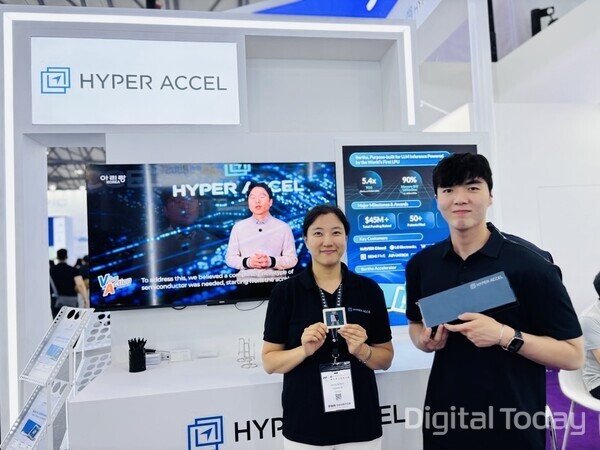
[Shanghai, China=DigitalToday reporter Daegeon Seok] Korean fabless chipmakers opened a Korea pavilion at Electronica Shanghai 2026 and knocked on the door of the Chinese market, where demand from the world’s largest automotive, home appliance and data centre sectors is concentrated. They brought inference chips, AI accelerators and infrastructure optimisation solutions. With Chinese local fabless firms growing quickly, they highlighted customisation, speed and cost performance that large companies find difficult to offer.
On July 2, three Korean fabless companies showing their competitiveness at the Korea pavilion at Electronica Shanghai 2026 were met. The reason they chose China was its scale. The number of automakers, home appliance makers, robot companies and data centre operators, and the size of demand, cannot be compared with Korea. Mass production and decision-making are also fast. All came to Shanghai to see this huge demand first-hand and broaden points of contact.
◆HyperAccel targets China’s appliance and robot markets with edge and on-device
HyperAccel targets China’s home appliance, robot and automotive markets with edge and on-device AI chips. Its main business is inference chips for data centres, but in Shanghai it put forward server-form products and an on-device AI chip scheduled to be released later this year. A HyperAccel official said, "We are also working with major Korean companies on cooperation in appliances and robotics," adding, "We came out to try to break into the Chinese market, which has many appliance makers and robot companies."
The core strategy is to target multiple verticals at the same time, including appliances, robots and automobiles, where there is demand for on-device AI. HyperAccel also judges that a trend in the Chinese market to mainly adopt low-power double data rate (LPDDR) memory rather than high-bandwidth memory (HBM) aligns with its chips.
Above all, this participation confirmed demand for AI adoption among foreign companies operating in China and local companies. It decided to continue communication with some companies and discuss testing its chips. A HyperAccel official said, "The chip itself is highly efficient, so it is competitive in the market," adding, "It will fit well with the Chinese market, which mainly uses LPDDR."
◆Boss Semiconductor: "A 250-TOPS accelerator that boosts system performance"
Boss Semiconductor is targeting the Chinese market with an AI accelerator that attaches to a company’s existing system. It is known for automotive semiconductors but is expanding into the physical AI area. A Boss Semiconductor official said, "It is an AI accelerator product. If customers attach it to a system they have been using without developing a new one, it is a concept that can expand AI performance," adding, "The hurdle to adoption is low, so many Chinese OEMs, tier-one suppliers and physical AI companies look for it."
Its competitiveness lies in a high-end 250-TOPS-class accelerator, chiplet technology and customised technical support as a startup. A Boss Semiconductor official said, "Global large companies have many customers, so it is difficult for small companies to receive one-on-one support," adding, "We have an agile approach that includes technical support." It is therefore putting weight on a large 250-TOPS-class NPU accelerator. The product introduced this time is high-end. It also includes low-end products for China, and it stressed above all that it is confident in its ability to tailor to customers.
This is Boss Semiconductor’s third participation in China. It came to Electronica Shanghai after attending Auto Shanghai last year and Auto Beijing early this year. It currently has a China sales representative and is discussing matters through regular conference calls with Chinese OEMs and physical AI companies. A Boss Semiconductor official said, "Compared with Korea, there are more and more diverse companies, including automakers, so demand is clear," adding, "China’s market, with fast mass-production cycles and decision-making, fits well with the characteristics of startups whose strength is fast response." The official added, "We plan to continue strengthening our business in the Chinese market as part of our strategy to expand the global market."
◆MangoBoost: "Exploring China market potential with a software LLM booster"
MangoBoost is tapping the Chinese market with a full-stack infrastructure optimisation solution that organically combines hardware and software. The company started from the recognition that while computing chip performance is advancing quickly, bottlenecks in data transmission, storage and processing reduce system efficiency.
Its first participation is largely aimed at market sensing. Hardware server inquiries are also continuing locally, but it plans first to build a collaboration system with AI software service providers in China and widen full-stack infrastructure touchpoints.
Its weapon for the Chinese market is a software LLM booster that optimises LLM models. By extremely optimising an open-source inference engine, it increased processing speed by 2 to 3 times in the same hardware environment. A MangoBoost official said, "Other hardware is also possible, including AMD GPUs, and we can deliver results with lower usage costs than Nvidia while achieving high performance," adding, "For customers seeking alternatives because Nvidia supply is insufficient, a combination with our solution delivers the optimal effect."
 Daegeon Seok
d2dg@d-today.co.kr
Daegeon Seok
d2dg@d-today.co.kr