
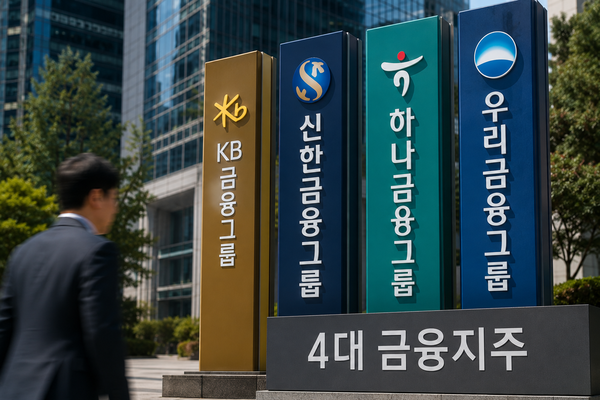
KB Financial, Shinhan Financial, Hana Financial and Woori Financial are expected to post more than 11 trillion won in net profit in the first half of this year, setting a new record for the period. Higher market rates have lifted banks' interest income, while stronger stock markets have improved results at securities units. Banks and non-bank units are both supporting earnings. If fines related to Hong Kong H-share equity-linked securities (ELS) are finalised, some provisions already set aside could be reversed, potentially providing an additional boost.
On July 3, the financial sector said financial data provider FnGuide expects the four groups' combined second-quarter net profit at 5.5661 trillion won. That would be up 2.1 percent from 5.4494 trillion won a year earlier. First-half cumulative net profit is forecast at 11.018 trillion won, up 5.2 percent from 10.4585 trillion won a year earlier.
That would make it likely the four groups set another record for first-half results this year, after doing so last year. Second-quarter profit alone is expected to top 5.5 trillion won, which would be the highest level for any quarter.
By group, KB Financial is expected to post 3.6587 trillion won in net profit in the first half, up 6.2 percent from 3.4467 trillion won a year earlier. Shinhan Financial is seen at 3.2654 trillion won, up 5.5 percent, and Hana Financial at 2.4802 trillion won, up 6.8 percent. Woori Financial is forecast at 1.5975 trillion won, up 0.2 percent from a year earlier.
In the second quarter, KB Financial's net profit is expected at 1.7422 trillion won, down 0.3 percent from a year earlier. Even so, its first-half profit is projected to remain the largest among the four, at around 3.6 trillion won. Shinhan Financial is expected to earn 1.6162 trillion won in the second quarter, Hana Financial 1.2496 trillion won and Woori Financial 958.1 billion won, each seen rising from a year earlier.
Bank interest income and a stock market boom broaden non-bank competition
The key driver of the improved results is bank interest income. Rising market rates and growth in loan assets have supported a steady trend in net interest margins and interest income at the major groups. As of the first quarter, interest income at all four groups rose from a year earlier. KB Financial and Shinhan Financial each posted interest income in the 3 trillion won range, while Hana Financial and Woori Financial also showed gains.
A recovery in non-bank units is also lifting earnings expectations. With domestic stock trading active, revenue from brokerage commissions, investment banking and wealth management is more likely to improve at groups with securities units. Bank interest income is supporting the base, while non-bank affiliates such as securities, insurance and card units are acting as additional growth engines.
Analysts also say non-bank competition among the groups could affect the earnings ranking this year. KB Financial is seen as having an advantage due to a balanced portfolio including banking, securities and non-life insurance. Shinhan Financial has also been cited for the possibility of acquiring a non-life insurer, appearing to seek to broaden its non-bank profit base and step up competition with KB Financial for the leading position.
ELS fine reversals seen as a variable; second-half differentiation in focus
Hong Kong ELS fines are also a variable. As the Financial Supervisory Service's sanctions review committee discussed ELS-related fines for 5 major banks at 600 billion won or less, financial groups that built provisions conservatively could expect some reversal effect after the final fines are confirmed. Some in the financial sector also project that provision reversals across the banking sector could total around 200 billion won.
KB Financial, which faces a relatively large fine burden, could also see a larger reversal effect. Given its large sales of Hong Kong ELS, any difference could return to profit if provisions already booked exceed the final fine. Still, it remains uncertain whether the effect will be reflected in second-quarter results because the timing of the Financial Services Commission's final decision and the actual fine amount have not been confirmed.
Expectations for full-year results are also rising. The four groups' combined net profit for this year is forecast to come close to 20 trillion won. If interest income and non-bank earnings hold at a certain level in the second half after record first-half results, overall profit resilience at the groups could rise another notch.
In the second half, stronger management of household loans, corporate loan asset quality and higher funding costs remain variables. Bank and brokerage strength lifted results through the first half, but some forecasts say differences among the groups could widen in the second half depending on credit costs and net interest margin trends.
A financial industry official said, "In the first half, interest income expanded due to higher rates and results at securities units improved at the same time, and financial holding group earnings were more resilient than expected." The official said, "In the second half, the profit contribution from non-bank units and whether credit costs are managed will be key variables in earnings differentiation."
 Ji-young Lee
ljy@d-today.co.kr
Ji-young Lee
ljy@d-today.co.kr