
Nokia unveiled AI-RAN, AI-based network operations and next-generation optical communications technologies to respond to the spread of AI services.
Nokia Korea held Amplify Korea 2026 at Four Seasons Seoul on Wednesday under the theme "Network innovation toward the AI supercycle". Domestic telecom operators and enterprise customers attended to share network technologies and market trends for the AI era.
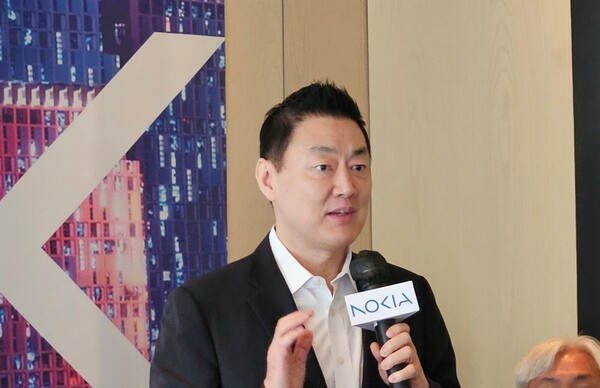
Tae-ho Ahn (안태호), CEO of Nokia Korea, stressed that as the shift to an AI-based economy accelerates, intelligent, scalable and automated networks are becoming more important. At a press briefing, Ahn said, "Nokia is also evolving from a company that connected people into one that connects intelligence."
Nokia introduced AI-RAN, a technology that supports running network functions and AI applications on shared infrastructure. It simplifies network operations and optimises performance based on AI-native and cloud-native architectures.
Hyo-chan Han (한효찬), Nokia's chief technology officer, said AI-RAN, cloud and open ecosystems can provide new services and revenue opportunities for telecom operators preparing for 6G. "A new workload called AI is demanding changes to networks," he said. "Connectivity must go beyond supporting AI and become a continuum where connectivity and AI are integrated," he added.
Nokia is also strengthening software technology. It is developing technology with Nvidia to run RAN software on general-purpose GPUs. It is preparing commercialisation in cooperation with T-Mobile, SoftBank and Indosat Ooredoo Hutchison (IOH).
Nokia Korea also unveiled AIOps technology that applies AI to operating internet protocol transport networks. Nokia's Network Services Platform uses an AI agent that recognises natural language to analyse the causes of faults and support recovery processes. A Nokia Korea official said this would reduce fault response time and support the transition to autonomous network operations, adding that an official launch is planned for next year.
It also demonstrated optical network technology linking AI data centres and the cloud. Nokia introduced low-latency, high-performance data centre interconnection technology for transmitting large AI workloads and quantum-resistant security features.
In fixed-line networks, it showcased technology that simultaneously provides 1 Gbps, 10 Gbps and 50 Gbps passive optical network services on a single optical network. It applied AI-based anomaly detection, fault resolution and network design functions to its broadband network management platform, Altiplano.
Ahn said as AI adoption spreads across industries, networks are becoming key infrastructure supporting the AI supercycle. He said Nokia would support the AI transition of domestic telecom operators and companies through innovation across fixed and wireless networks.
 Jin-ho Lee
jhlee26@d-today.co.kr
Jin-ho Lee
jhlee26@d-today.co.kr