
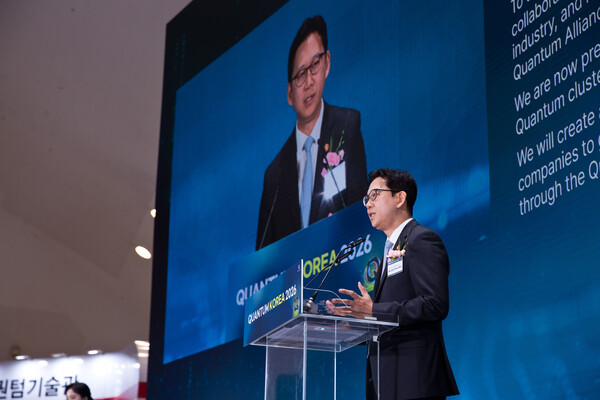
Bae Kyung-hoon (배경훈), deputy prime minister and minister of science and ICT, presented quantum technology as a national growth engine after AI. He outlined a plan to develop it into a core technology that will lead future society through large-scale investment.
In opening remarks at the Quantum Korea 2026 ceremony held at Dongdaemun Design Plaza (DDP) in Seoul on July 2, Bae said, "It seems quantum comes after AI." He said he believes quantum will play an important role in shaping future society.
Launched in 2023, Quantum Korea is the country’s leading quantum event where governments, researchers and leading quantum companies from around the world gather to share the latest technologies and policies.
Bae said, "The current AI computing method requires a tremendous amount of cost and electricity. I believe it will reach its limit at some point." He explained that for artificial general intelligence (AGI) to come closer to daily life, advances and commercialisation in computing technology are essential.
Bae said quantum technology is likely to be highly useful not only in computing but also in areas such as sensing and encryption. He particularly assessed that results are emerging in the field of encryption.
Bae also referred to the government’s "three mega projects" and stressed that the quantum field also needs national-level investment and nurturing plans. The government previously presented semiconductors, physical AI and AI data centres as three mega projects to build an "irreplaceable Republic of Korea."
Bae said companies, industry-academia cooperation and the government must join forces to develop sweeping investment and nurturing plans for the quantum sector.
Song Ki-heon (송기헌), chair of the National Assembly’s Science, ICT, Broadcasting and Communications Committee, stressed international solidarity. In his remarks, Song said, "Quantum technology is at a point of moving beyond scientific potential to a reality that affects the economy, security and society as a whole." He stressed that solidarity and cooperation across borders are essential for it to become a future innovation.
 Jin-ho Lee
jhlee26@d-today.co.kr
Jin-ho Lee
jhlee26@d-today.co.kr