
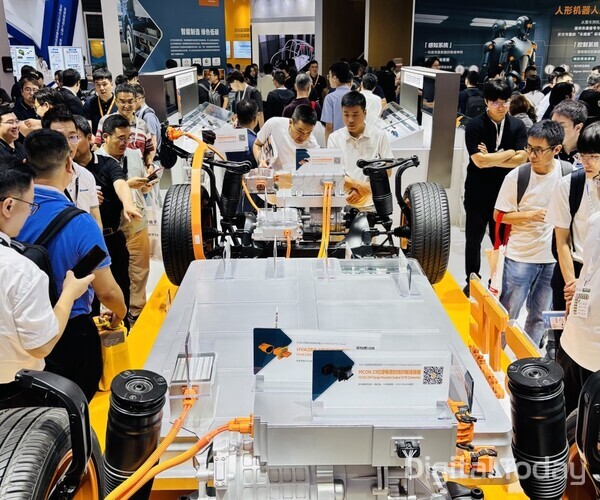
[Shanghai, China = DigitalToday reporter Seok Dae-geon] The focus of competition in intelligent driving is shifting from securing higher computing power to reliably delivering performance under limited power. This was on display at Electronica Shanghai 2026, which opened on July 1. Texas Instruments showcased scalable automotive SoCs ranging from 10 to 1,200 TOPS, while TE Connectivity displayed 15 GHz and 56 Gbps automotive connectors. It signals that software functions can be realised only to the extent supported by chip and connector performance.
The change was evident across booths. As end-to-end large models are being installed in intelligent driving in earnest, the key is narrowing to hardware designs that preserve signal integrity and compute density to the limit within constrained power and space, rather than absolute computing power. TI highlighted its TDA5 SoC designed to balance performance with power and safety across a 10 to 1,200 TOPS range. Its AWR2188 4D imaging radar emphasised a single-chip 8TX/8RX structure. SmartSense targeted input data quality under extreme lighting with its SC860AT automotive image sensor, at 8.3 megapixels and 140 dB HDR.
As competition standards for eco-friendly cars shift from driving range to charging speed, the burden is falling directly on power and thermal management components. As voltage platforms rise from 800V to above 1,000V, faster charging increases heat generated in power semiconductors. Wuxi Nengyuan's 2,000V rectifiers WND60P20W and WND90P20W were designed for extreme conditions in 1,000 VDC EV charging infrastructure, to reduce risks to component life from voltage spikes and stray inductance. Wuxi Nengyuan introduced the products for O-ring diode use supplied to a global top-three EV charging module company.
Thermal management is moving beyond simple heat dissipation to precisely coordinating energy flow. Novosense demonstrated a thermal management controller that controls key components such as electric water pumps and coolant valves at the chip level and links to a zone controller via CAN-FD. It shows that power electronics and thermal management have become a first gateway in the race for charging speed, not auxiliary technologies.
◆ Connector design dilemma driven by high voltage and lightweighting
High-voltage flows have brought a new dilemma to connector design. At one booth, staff discussed lightweighting high-current connectors. Replacing copper with aluminium reduces weight, but there were concerns that inadequate treatment of connection areas could damage contacts through corrosion. It showed the challenge of high-voltage connectors that must achieve both low weight and reliability. Detachment methods were also a topic. A bolt-fastened structure has strong holding force but requires bolts to be loosened first when separating, while high-voltage interlock loop, or HVIL, offers a different balance between safety and convenience.
In data centres, the power supply route itself emerged as an issue. One visitor pointed out that bringing 12V and 60A to a GPU via the edge of a board increases line loss in that section as current rises, and booth staff explained a vertical power delivery route to address it. It means that where to place the distribution structure has become a variable that determines losses as current increases.
The changing status of connection components was also clear. As vehicle-road-cloud integration moves beyond pilot stages into large-scale deployment, in-vehicle data traffic is surging and the reliability of connections that carry data without loss has become system performance.
TE Connectivity's GEMnet connector supports up to 56 Gbps with 15 GHz bandwidth, targeting automotive Ethernet and ultra-high-definition display connections. Rosenberger addressed systems of 800V and above with its next-generation high-voltage connector HVR 25, which supports 40A continuous current at 85 degrees Celsius based on 4 square millimetres of copper wire. Connectors once seen as auxiliary parts have become the "spine" of next-generation automotive electronics infrastructure.
These trends converge in one place. As AI functions and electrification spread at the same time, the value of the underlying hardware that implements them is rising. In the chain from computing and sensing to power and thermal management and connectivity, the completeness of components sets the upper limit of system performance. As cars move beyond the stage of "adding AI" to the stage of "stably supporting AI", the exhibition offered a clear view of the front line of that transition.
 Seok Dae-geon
d2dg@d-today.co.kr
Seok Dae-geon
d2dg@d-today.co.kr