
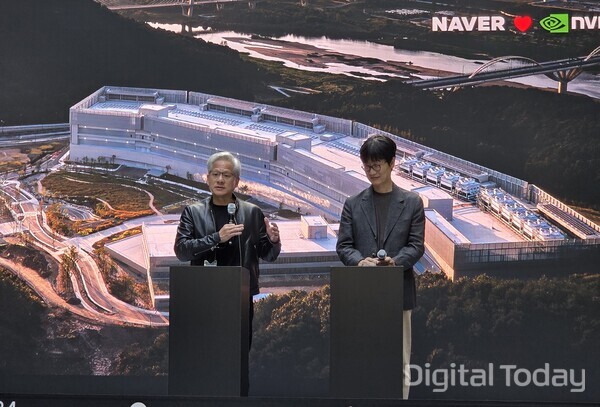
Naver has made artificial intelligence (AI) infrastructure a new growth pillar. It is moving into a business-to-business (B2B) infrastructure business targeting global AI computing demand, beyond domestic search, shopping and advertising. The core is its “AI factory” business 추진 with Nvidia.
Naver’s push into the AI factory business reflects structural limits in its existing platform businesses. Search advertising and commerce remain key revenue sources, but growth is capped because the businesses are tied to a domestic user base.
Lee Chang-young (이창영), an analyst at Yuanta Securities, pointed to the need for a new revenue model that can deliver global growth beyond the limits of the existing Korea-centric search and shopping revenue model.
The AI factory is a card that can supplement the existing revenue structure. The idea is to secure a new revenue source through a B2B infrastructure business that absorbs global AI computing demand.
AI factory is not simply a data centre
An AI factory differs from an existing data centre. If a data centre is closer to a warehouse that stores and rents servers, an AI factory is closer to a plant that trains AI models and performs inference and production for services. It integrates graphics processing units (GPUs), high-speed networks, power, cooling systems and operating software as a single production facility. That is why Nvidia highlights it as a next-generation core infrastructure business.
The two companies’ plans are specific. They will begin first operations at 55MW in the first half of next year, expand to 100MW by the end of that year, and grow to 200MW cumulative by the end of 2028. The long-term goal is gigawatt-scale. Nvidia CEO Jensen Huang (젠슨 황) visited Naver’s “1784” headquarters on June 8 and said at a meeting with Naver board chairman Lee Hae-jin (이해진) that if it builds a 1GW AI factory, Naver will become a company 10 times larger than it is now. Naver expects annual revenue to reach about 20 trillion won when a 1GW-class data centre is completed around 2030 to 2031.
Naver has a clear reason for trying to go beyond simple infrastructure leasing. In the securities industry, CoreWeave’s revenue 규모 is being compared at about 10 trillion won a year based on 850MW. The basis for Naver presenting a figure twice as high at 20 trillion won for 1GW lies in software and services. Naver has experience applying its in-house large language model (LLM), HyperCLOVA X, to real services. On that basis, it aims to be a “full-stack” provider that, in addition to GPU usage fees, retrains AI models to fit customer data or provides industry-tailored AI solutions.
Choi Seung-ho (최승호), an analyst at DS Investment & Securities, assessed Naver as one of a small number of full-stack AI players that have mass-produced and commercialised foundation models, and explained that it aims to link the entire cycle from infrastructure to applications, not simply rent out infrastructure. This differentiation is the key that separates Naver from simple GPU leasing operators.
The demand Naver is especially targeting is “sovereign AI”. It refers to AI that governments and companies in each country build independently to match their own language, regulations and industry data. In areas handling sensitive information such as defence, finance and healthcare, it is difficult to entrust data to general-purpose AI models from U.S. big tech companies. Naver plans to penetrate this market by combining HyperCLOVA X with AI factory infrastructure. For Nvidia as well, as big tech companies such as Google and Amazon increase their own chip development, it needs a trusted partner to jointly target the Asian sovereign AI market. That is why Naver has emerged as Nvidia’s AI factory 협력 partner.
The blueprint is drawn, but execution is key
Even so, there are many challenges to overcome for the blueprint to translate into actual monetisation.
The first task is customer contracts. The securities industry expects AI factory revenue to start in the second half of 2027. Some forecasts say annual revenue of around 1 trillion won is possible if a first-phase customer now under discussion takes the entire initial 200MW volume.
Customer contracts must come first because they are directly tied to fundraising. About $10 billion, or about 14 trillion won, is needed just for investment up to the 200MW stage, and total funding cited in the market to expand to 1GW is $30 billion to $60 billion, or about 43 trillion won to 80 trillion won. Yuanta Securities’ Lee Chang-young explained that Naver and strategic partners plan to invest about $1 billion each, with the rest to be raised from outside investors.
Naver is also said to be reviewing a structure that separates asset ownership and operations. Under the approach, a separate special purpose vehicle (SPV) would own GPU and data centre assets, while Naver would lease and use them, allowing it to focus on operations without directly taking on large-scale assets.
Naver said at an NDR that it will 추진 mainly long-term supply contracts for the time being because visibility of future cash flow is important to smoothly attract external funding. The structure is such that long-term contracts must be secured to bring in outside investment, and investment must be raised for infrastructure construction to gain speed.
Power, sites and technology: variables that will determine the pace
Power and site issues are another hurdle. A greenfield expansion of the Sejong data centre “Gak Sejong” was initially seen as the key hub, but it is expected to take longer than anticipated due to power supply conditions. As a result, the securities industry sees a strong likelihood that the first operating volume in the first half of 2027 will be centred on separately leased space rather than Sejong’s own expansion. Naver is currently looking for available space in major industrial complexes in South Korea and across Asia including Japan and Southeast Asia.
Still, if policy support materialises, the burden of securing power and sites could be eased somewhat, as the government on June 29 presented AI data centres as one of three mega-projects and promised support for power, water, sites and permits.
The scale of the power issue is shown in the numbers. Naver’s 2025 integrated report projects its power usage will reach about 3 times the current level at 1 terawatt hour (TWh) in 2040. That is roughly equivalent to the electricity used in a year by about 280,000 households in Seoul. AI factories have far higher power density than 일반 data centres. Based on Nvidia’s H100 and H200, power consumption per GPU exceeds 700W, and based on a GB200 NVL72 rack, total rack power consumption reaches 120 to 130 kW. Even if GPUs are secured, it is difficult to operate an AI factory without sufficient power and cooling facilities. Naver’s power purchase agreement (PPA) with GS Wind Power in April, along with its acquisition of a 30 percent stake, was for this reason. It aims to secure 180 gigawatt hours (GWh) of renewable energy annually from the first half of 2028 to manage both power demand from AI factory expansion and carbon costs.
There are also technology-change risks. If AI model efficiency improvements proceed quickly, computing demand itself could decline, and the possibility of new technologies emerging that replace Nvidia GPUs cannot be ruled out. Yuanta Securities’ Lee Chang-young cited obstacles to hitting target returns including mismatches between revenue and costs due to differences in the pace of AI computing demand growth, and the possibility of new technologies replacing Nvidia GPUs or development of highly efficient AI models.
Whether the AI factory can become a new growth pillar for Naver, the first gate is long-term customer contracts. Contracts must be secured for fundraising and facility construction, and securing power and sites must follow for actual operations. Cooperation with Nvidia is a starting point. The key question is whether it can be connected to sustainable revenue and profit.
 Lee Ho-jung
lhj@d-today.co.kr
Lee Ho-jung
lhj@d-today.co.kr