
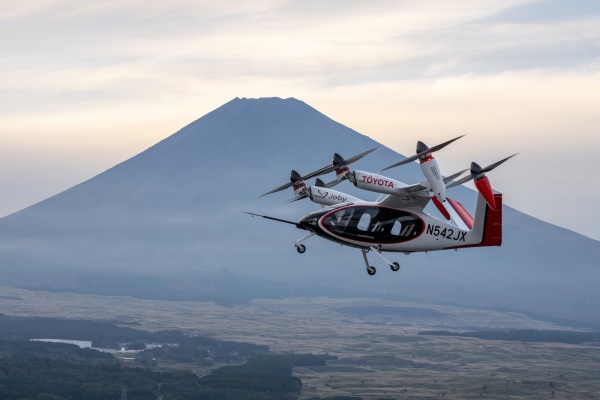
[DigitalToday reporter Jinju Hong] Toyota and U.S. electric vertical takeoff and landing aircraft (eVTOL) developer Joby Aviation have begun a strategic manufacturing partnership for commercial production of electric air taxis. The two companies are setting up a joint venture and moving to build a mass-production system, stepping up efforts to target the advanced air mobility (AAM) market.
The companies have set up a joint venture for commercial eVTOL production called Joby Toyota Aero Manufacturing Preparation Company, Cleantechnica, an electric-vehicle specialty outlet, reported on June 30 (local time).
In the early stage, the joint venture will focus on building production systems and improving productivity, quality and cost competitiveness. It later plans to support aircraft certification processes and gradually expand production capacity in line with market growth.
The partnership centres on combining Joby's aviation technology with Toyota's manufacturing know-how. Joby will be responsible for eVTOL design and development, while Toyota will apply manufacturing operations experience accumulated through global auto production to build a stable mass-production system.
Toyota will hold 51 percent of the joint venture and Joby 49 percent. That gives Toyota management control, while Joby plays a central role in product development and technology.
The two companies have worked together before. Joby founder and Chief Executive Joben Bevirt (조벤 베버트) explained that Toyota has provided continued support over the past 10 years as Joby built its aircraft manufacturing base. "This announcement once again shows that the two companies share the same vision for future air mobility," he said. "Our joint goal is to make air mobility an everyday means of transport."
Toyota also described the partnership as an extension of its existing mobility strategy. Toyota Motor Chairman Akio Toyoda (아키오 토요다) said Toyota has pursued mobility for everyone since its founding. He said air mobility is a natural evolution of that philosophy from the ground to the sky. He added that building future mobility with Joby, which shares the same vision, is a very meaningful challenge.
The announcement did not include specific production targets, schedules or profitability plans. At the current stage, the focus is on refining production systems and preparing for mass production rather than declaring large-scale commercialisation. In particular, the productivity, quality and cost improvements highlighted by the two companies are areas that have been cited as key challenges for the eVTOL market.
Against this backdrop, the joint venture focuses on securing manufacturing execution rather than technology development. Joby plans to lead with its electric aircraft development capabilities, while Toyota aims to apply its global manufacturing operations experience to lower the barrier to commercial production. The two companies are expected to test the practical feasibility of commercialising the air mobility business as they expand production capacity in line with certification procedures and growing demand.
 Jinju Hong
hongjj@d-today.co.kr
Jinju Hong
hongjj@d-today.co.kr