
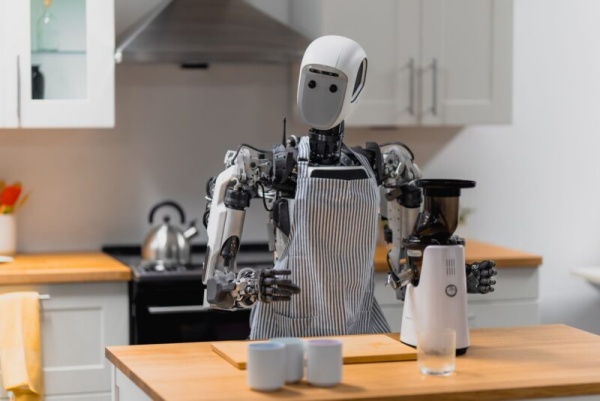
U.S. humanoid robotics startup Apptronik has unveiled a large-scale robot training facility called Robot Park, stepping up efforts to commercialise humanoids. It plans to secure large volumes of training data in real work environments to improve artificial intelligence (AI) performance.
Business Insider reported on June 30 local time that Apptronik has built a robot training facility of about 90,000 square feet, or about 8,360 square metres, in Austin, Texas.
There, the company's humanoid robot Apollo repeatedly performs tasks such as moving boxes on a conveyor belt or sorting toys, accumulating data.
Apptronik is a humanoid startup backed by Google and Mercedes-Benz as key investors. The company defined the facility not as a simple research space but as a "data factory" that produces robot training data. Jeff Cardenas (제프 카르데나스), Apptronik's co-founder and chief executive officer, said, "Just as there are factories that build robots, there also need to be factories that create the data to train robots." He added, "Robot Park is a playground where humanoids learn about the world."
Apollo is currently trained mostly through teleoperation. The facility operates year-round, with workers directly guiding and monitoring the robot's movements. The data accumulated this way is used to improve the robot's AI model. Apptronik aims to expand humanoid use in the future to factories and logistics warehouses, as well as service businesses and home environments.
The industry cites securing real-world environmental data as the biggest challenge to commercialising humanoids. That is because generative AI can use vast text and image data accumulated on the internet, but physical data from the real world for humanoids to learn from is relatively scarce.
Apptronik expects Robot Park to be key infrastructure for addressing this data shortage. Apptronik, spun off in 2016 from the Human-Centered Robotics Lab at the University of Texas, was founded based on robotics research achievements from the U.S. Defense Advanced Research Projects Agency (DARPA).
The company said it initially developed industrial robot components, but its ultimate goal was to develop general-purpose humanoids. It has raised about $1 billion so far and is valued at more than $5.5 billion. Investor Mercedes-Benz is already trialling Apollo on production lines to carry parts and tools, and Google DeepMind is using Apollo to develop its robot AI model, Gemini Robotics.
Apptronik unveiled the first Apollo in 2023 and now operates Apollo2, with improvements to batteries, sensors and actuators. Apollo2 can run for up to 4 hours on a single charge, stands about 183 cm tall, and can lift about 25 kg with both hands. The company is also developing Apollo3, a model for commercial sales, but did not disclose a launch schedule.
Cardenas said the humanoid market will grow through three stages: technology validation, confirming customers' willingness to pay, and scaling profitable businesses. He said the industry has entered the second stage, adding, "Humanoids are like the personal computers of our era. Right now, it is similar to the PC market in the early 1980s."
Market competition is also moving from an experimental stage to early commercial testing. Figure AI has begun deploying humanoids at logistics centres, and 1X aims to ship more than 10,000 home humanoids by the end of this year. Agility Robotics has already supplied Digit to sites of major customers including Amazon, Toyota and GXO.
Apptronik is also pursuing a strategy of developing both wheeled and walking humanoids. The company sees wheeled models as more advantageous for commercialisation in the short term due to higher mobility efficiency, but believes walking humanoids have greater potential in the long run because they can adapt to work environments designed for people.
Cardenas said, "Our goal is to build Robot Parks around the world and let the public directly see the process of developing the robots of the future." He added, "In the humanoid race, the key is shifting from hardware to how much data you can secure."
 Jinju Hong
hongjj@d-today.co.kr
Jinju Hong
hongjj@d-today.co.kr