
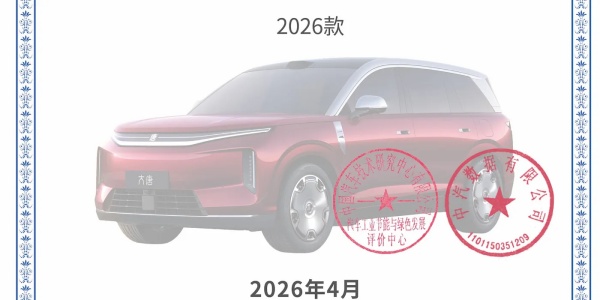
[Digital Today reporter Jinju Hong (홍진주)] BYD’s flagship electric sport utility vehicle (SUV), the Great Tang, is stepping up its push into China’s large electric SUV market after receiving official certification for ride comfort and anti-motion-sickness performance.
On June 30, local time, electric-vehicle outlet Electrek reported that the Great Tang recently obtained ride comfort and anti-motion-sickness performance certification from the China Automotive Technology and Research Center (CATARC).
The certification is seen as an example of BYD’s strategy to differentiate large SUVs not only by driving performance but also by passenger convenience. The Great Tang is BYD’s first D-segment flagship SUV. Since it began taking pre-orders at the Beijing motor show in April, reservations have exceeded 150,000 units. It is the largest pre-order record for a single BYD model.
Its biggest feature is motion-sickness reduction technology. BYD said it applied the industry’s first “Multi-dimensional Anti-Motion Sickness Mode”. The function analyses driving conditions in real time and automatically adjusts the vehicle’s control methods. Linked to BYD’s intelligent body control system, DiSus, it smooths acceleration, adjusts suspension response and eases body movement during cornering to reduce motion sickness for occupants.
Lu Tian (루 톈), head of BYD’s Dynasty series, said the Great Tang received official ride-comfort certification after its smooth driving performance was recognised. BYD introduced the vehicle as having “29 world first” technologies. It cited, among others, up to 950 km of range under the CLTC standard, ultra-fast flash charging and China’s first 2+2+2 seating layout.
The interior is also configured to target premium SUVs. It has three large displays spanning the driver’s seat, centre and front passenger seat, and also offers a ceiling-mounted entertainment display for second-row passengers. The front seats and second row use Zero Gravity-style individual seats supporting heating, ventilation and massage functions. An in-cabin refrigerator is also included as a standard feature.
Battery and charging performance also target competitiveness in large electric SUVs. The base model has a 105.79 kWh Blade Battery 2.0 and can drive up to 800 km under CLTC. The higher-end flagship model has a 130.15 kWh battery for up to 950 km. It is offered in two drivetrain options: single-motor and dual-motor.
Charging performance also draws attention. BYD explained that the Great Tang applies a 1,000-volt ultra-high-voltage platform and flash charging technology, allowing the battery to charge from 10 percent to 70 percent in about 5 minutes. It is assessed as boosting usability for large SUVs by securing both long-distance driving and short charging times.
Its body size also exceeds competing models. The Great Tang is 5,263 mm long, 1,999 mm wide and 1,800 mm high, with a 3,130 mm wheelbase, making it larger than Hyundai Motor’s Ioniq 9. Its China sales price starts at 239,900 yuan.
BYD is expected to introduce the Great Tang in the European market by the end of this year after its launch in China. The industry views the Great Tang as a key model to lead BYD’s global strategy to expand large electric SUVs from simple means of transport into premium spaces for work and rest, backed by long-range performance, ultra-fast charging and passenger convenience.
 Jinju Hong
hongjj@d-today.co.kr
Jinju Hong
hongjj@d-today.co.kr