
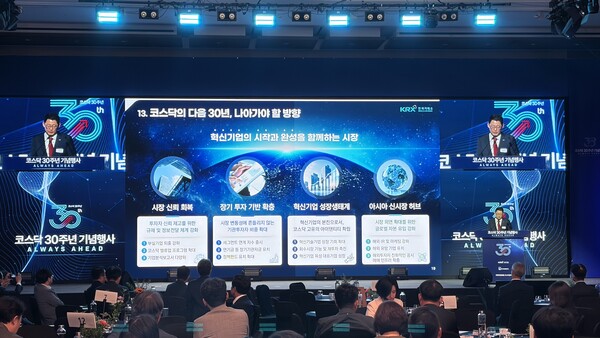
The Korea Exchange is pushing a restructuring of the KOSDAQ market as it marks the market's 30th anniversary. It set out introducing segments and tightening delisting rules as key tasks to improve a structure where strong and weak companies are mixed and to restore investor trust.
Choi Ji-woo (최지우), a managing director at the Korea Exchange's KOSDAQ Market Division, said at an event on Tuesday marking the 30th anniversary of the opening of the KOSDAQ market that the market must resolve issues of trust and undervaluation to become a fully developed market.
The KOSDAQ market opened on July 1, 1996. The number of listed companies rose to 1,827 as of end-2025 from 341 at its launch. Market capitalisation grew from about 7 trillion won at the outset and topped 600 trillion won for the first time ever in January this year.
Trading has also grown. Average daily turnover expanded to about 14.1 trillion won this year from about 22.2 billion won in the early days. KOSDAQ climbed back above the 1,000 level in January 2026, and reached 1,226 points on April 27, its highest level since the dot-com bubble.
Qualitative growth continued. In 2025, KOSDAQ-listed companies posted revenue of 297 trillion won, operating profit of 11.7 trillion won and net profit of 5.2 trillion won, up 8.8 percent, 21.9 percent and 52.9 percent, respectively, from a year earlier. The number of cases of companies designated for unfaithful disclosure also fell to 81 in 2025 from 113 in 2024.
The share of advanced industries has also expanded. Choi said KOSDAQ diversified beyond a manufacturing-focused structure into advanced industries such as artificial intelligence (AI), biotech, semiconductors, defence and aerospace. He said the share of advanced-industry companies in new listings was 34 percent in 2023, 36 percent in 2024 and nearly 50 percent in 2025.
Still, market trust and undervaluation were cited as challenges. Delays in removing weak companies have allowed some to remain for long periods and be exploited for unfair trading, while the mix of strong and weak companies in one market has led to undervaluation of KOSDAQ as a whole, it said.
The exchange plans to tighten its delisting system. It will introduce delisting rules for low-priced shares and penny stocks below 1,000 won, and gradually raise market-capitalisation and revenue thresholds for removal. It will also rationally shorten substantive review procedures and tighten cumulative penalty-point standards for unfaithful disclosures.
The number of companies facing delisting decisions is expected to increase. The number of firms decided for delisting on KOSDAQ rose to 38 in 2025 from 8 in 2021. The exchange expects the number of companies decided for delisting this year to reach about 88.
The exchange is also reviewing the introduction of segments. It is considering creating a new segment tentatively named “KOSDAQ Select” that groups leading high-quality companies, aiming to ensure companies with growth potential and stability receive clear evaluations within KOSDAQ.
Choi said the aim of introducing segments is to build a market where innovative companies can grow and investors can invest with confidence. He said it is also expected to provide institutions with usable investment criteria and enhance the brand effect of KOSDAQ’s top companies, easing incentives to move listings to KOSPI.
For risky companies, it will apply intensive management through a separate management group. The exchange plans to run the system in a flexible and dynamic way that allows companies to move between segments through regular re-evaluations.
The exchange will also upgrade screening for technology-based special listings. It plans to establish qualitative review standards for advanced innovative industries such as AI, biotech, semiconductors, defence and aerospace, and expand the standards to areas such as advanced robotics and cybersecurity.
Choi stressed that it is important not to uniformly raise or lower thresholds, but to assess technological capabilities more accurately and establish a consistent screening system.
The exchange presented restoring market trust, expanding the base for long-term investment, building an ecosystem for the growth of innovative companies and advancing as an Asian hub for new markets as future priorities.
Choi said if the KOSDAQ market has supported the growth of innovative companies over the past 30 years, the next 30 years should develop that role in a more reliable and sustainable direction. He said it will push institutional improvements while communicating sufficiently with the market.
 Oh Sang-yeop
yub@d-today.co.kr
Oh Sang-yeop
yub@d-today.co.kr