
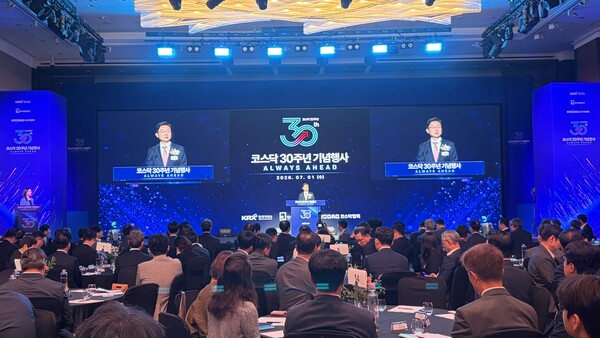
Talk is gaining pace on restructuring the Kosdaq market as it marks its 30th anniversary. The government and Korea Exchange plan to restore trust in Kosdaq by weeding out troubled firms, supporting listings of innovative companies and separating market segments.
A ceremony marking the 30th anniversary of the opening of the Kosdaq market was held on Tuesday at Conrad Seoul in Yeouido, Seoul. Attendees included Financial Services Commission Chairman Lee Eok-won (이억원), Korea Exchange Chairman Eunbo Jeong (정은보), Oh Ki-hyung (오기형), head of the Democratic Party’s K-Capital Market Special Committee, and venture industry officials.
Since its launch in 1996, the Kosdaq market has served as a funding channel for small and venture companies.
Lee said the number of listed firms is 5.4 times higher than in the market’s early days, market capitalisation has increased 73-fold and trading value has risen 7,000-fold. He said he would push structural improvements so the market can become a destination for growth-stock investing and develop into the world’s top technology stock market.
The government plans to strengthen productive finance to support listings and growth of innovative companies. It aims to create a structure in which investment, exits and reinvestment continue, by expanding the cap on small public offerings, requiring large investment banks to supply venture capital, investing in advanced strategic industries through the National Growth Fund, and creating venture secondary funds worth at least 2 trillion won.
A restructuring of the Kosdaq market is also planned. The Financial Services Commission plans to select representative companies through segment separation, and support institutional investors’ benchmarks, index inclusion and development of linked exchange-traded funds (ETF). The aim is to create an environment in which strong companies can remain on Kosdaq and grow.
Cleaning up troubled firms to restore market trust was also presented as a key task. Lee said there has been ongoing concern that troubled marginal companies damage confidence across the market and lead even strong companies to be undervalued. He announced plans to strengthen delisting requirements and operate an intensive management period.
Jeong also stressed the need to improve the market’s fundamentals. He said that even amid an unprecedented capital market boom, a virtuous cycle of joint growth between small venture firms and big companies, and between Kosdaq and KOSPI, has yet to take root. He said he would swiftly resolve troubled marginal companies to raise market confidence.
The exchange plans to fill vacancies left by troubled firms with innovative technology companies. Jeong said it would expand tailored technology-based special listing programmes so innovative companies, including those in artificial intelligence (AI) and defence, can list in a timely manner. He said the exchange would restore Kosdaq’s dynamism through market restructuring, including an escalator-style segment.
The National Assembly is also expected to support discussions on reforming the Kosdaq market. Oh said capital market reform is being pushed without distinguishing between KOSPI and Kosdaq. He said he believes Kosdaq must deliver even bigger changes, matching those in KOSPI.
Oh said performance and market trust are important for Kosdaq’s continued growth. He said it is important whether Kosdaq can create sustained and stable growth, and that questions continue over whether the market’s function of distinguishing troubled firms from innovative companies is working properly.
The government and the exchange will also strengthen responses to unfair trading. They plan to raise market trust through an expanded joint response team against stock price manipulation, a whistleblower reward scheme and systems to detect unfair trading. They will also push investor protection measures, including a principle ban on duplicate listings and recognition of exceptions, and the introduction of cornerstone investors and a pre-demand forecasting system.
Lee said improving Kosdaq’s fundamentals is a task that can no longer be delayed for Kosdaq’s future and for the economy’s renewed leap forward. He said it requires a combination of the government’s policy efforts, the exchange’s responsible market management and companies’ efforts to drive innovative growth.
 Sangyeop Oh
yub@d-today.co.kr
Sangyeop Oh
yub@d-today.co.kr