
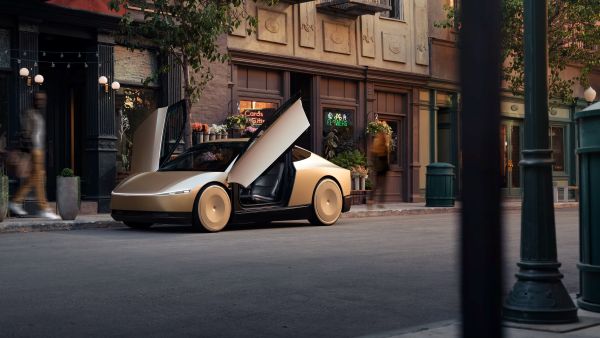
Tesla has begun test drives of its "Cybercab" without a steering wheel or pedals on roads in Austin, Texas.
On June 30 local time, foreign media including electric-vehicle outlet InsideEVs reported that Tesla posted a 27-second video on X, formerly Twitter, and announced the start of road tests of the steering wheel-free Cybercab.
The video showed a safety monitor sitting in the seat on the right side of the vehicle. The Cybercab is designed as a two-seat robotaxi, but this vehicle removes traditional driving controls entirely, making both left and right seats effectively passenger seats.
The idea of building the Cybercab without driving controls is not new. Elon Musk (일론 머스크) confirmed at a launch event in October 2024 that it would not have conventional controls inside. But all test vehicles previously spotted on public roads had standard steering wheels and pedals. This test is meaningful because it is closer to the robotaxi form Tesla originally presented.
The issue is emergency response. Robotaxis that Tesla and Waymo have put into commercial service all have steering wheels and pedals as backup. That is to allow rescue workers or company staff to move the vehicle directly in an emergency. Some services can also remotely operate the vehicle from a control centre for such situations.
The Cybercab faces a different task from rivals on this point. Tesla has said it will sell the Cybercab to individual customers. Unlike competitors that operate their robotaxis themselves, privately owned vehicles are not easy for a company to retrieve immediately or control directly when software or hardware problems occur. It has also not been confirmed whether an owner could move the vehicle if cameras are physically damaged or a software malfunction occurs.
Tesla's video did not show how the safety monitor could control the vehicle. Industry officials said the presence of a safety driver is clear, but how that person actually controls the vehicle is unknown. Because precise control through on-screen operation alone may have limits, they said it cannot be ruled out that a separate control device was connected.
Tesla is continuing to push its self-driving plans. The company has said it could launch the Cybercab before 2027. That leaves a key question of whether it can secure full self-driving software capable of operating without any steering wheel or pedals by then.
Even so, the timeline and implementation remain unclear. For commercialisation, it must prove not only road performance but also breakdown response, remote support and a vehicle retrieval system. In particular, if Tesla maintains an individual-sales model unlike existing rivals, it may need to present a different solution for the robotaxi operating structure itself.
Engineering tests of the first production Cybercab have begun in Austin pic.twitter.com/fk3KQvcE8a
 Seung-a Yoo
ysah@d-today.co.kr
Seung-a Yoo
ysah@d-today.co.kr