
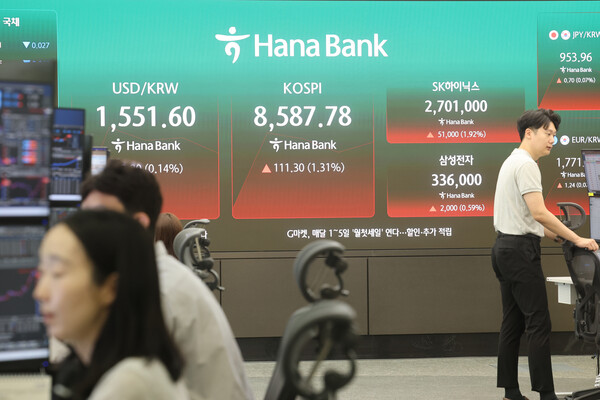
The KOSPI opened higher, helped by gains in U.S. tech stocks and a rebound in semiconductor shares. The Kosdaq, marking its 30th anniversary, was moving in slightly negative territory in early trade.
As of 9:13 a.m., the KOSPI was up 67.36 points, or 0.79 percent, from the previous session at 8,543.84. The index opened up 115.02 points, or 1.36 percent, at 8,591.50 and briefly returned above the 8,600 level, but pared some gains.
In the main board market, institutions were net buyers of 410.4 billion won. Retail investors and foreigners were net sellers of 41.2 billion won and 361.6 billion won, respectively.
Among top stocks by market value, Samsung Electronics was unchanged from the previous session at 334,000 won. SK Hynix was up 19,000 won, or 0.72 percent, at 2,669,000 won.
Samsung Electro-Mechanics rose 3.39 percent, Hyundai Motor gained 3.64 percent and HD Hyundai Heavy Industries climbed 3.21 percent. SK Square fell 2.06 percent, LG Energy Solution lost 1.66 percent, Samsung Life declined 1.12 percent and Samsung C&T slid 3.63 percent.
The Kosdaq was down 1.11 points, or 0.12 percent, from the previous session at 915.07. The Kosdaq marked its 30th anniversary on Wednesday. With the Kosdaq recently lagging the KOSPI, attention is on whether expectations for market-boosting policies and perceptions of an oversold pullback will lead to a recovery in demand.
In early trade, the won-dollar exchange rate was up 3.90 won, or 0.25 percent, from the previous session at 1,551.90 won per dollar.
Overnight, U.S. stocks ended higher on strength in semiconductors and large-cap tech shares. Semiconductor momentum continued in Micron and SanDisk, while Nvidia and Apple also rose.
Han Ji-young (한지영), an analyst at Kiwoom Securities, said the end of quarterly and half-year rebalancing events, strength in U.S. semiconductors and M7 stocks, and a rebound in KOSPI 200 overnight futures were expected to create a stronger trend. Han said South Korea's June exports and item-by-item export results, including semiconductors, would add differentiation to the momentum of related sectors during the session.
 Sangyeop Oh
yub@d-today.co.kr
Sangyeop Oh
yub@d-today.co.kr