
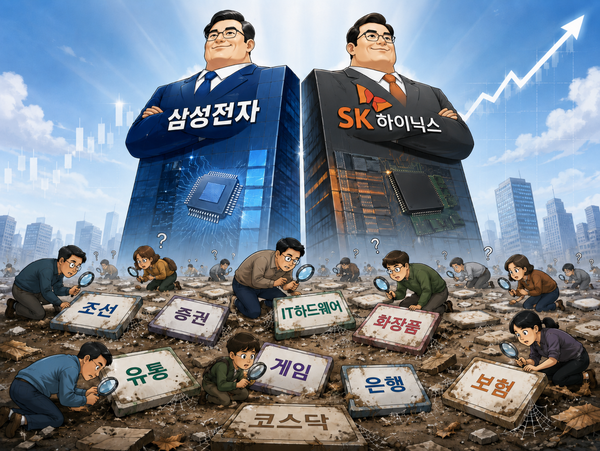
In the second half, South Korea's stock market is expected to remain led by large semiconductor shares centered on Samsung Electronics and SK Hynix. The key question is whether demand can spread to non-semiconductor sectors such as shipbuilding, securities and IT hardware, and to the Kosdaq.
With concentration in semiconductors strengthening recently, the index stayed near record highs, but the market feel was mixed. The KOSPI repeatedly swung sharply on the strength of large chip shares, while the Kosdaq and small and mid-cap shares were relatively weak.
According to Mirae Asset Securities, the KOSPI fell 1 percent in June, but volatility widened sharply, with a high of 9,386 and a low of 7,394. Over the same period, the Kosdaq fell 14 percent.
Within the KOSPI market, the combined market capitalization weight of Samsung Electronics and SK Hynix rose to about 56 percent, and the average KOSPI ADR in June fell to 59 percent, meaning more stocks declined.
Brokerages see a high chance that semiconductors will remain the market’s central axis in the second half. They cite an ongoing artificial intelligence (AI) investment cycle, and the possibility that profit forecasts could be revised up further during the second-quarter earnings season and in the process of confirming semiconductor supply contracts for 2027.
KOSPI forecasts are also being raised. Korea Investment & Securities presented an expected KOSPI range of 8,000 to 11,000 for the second half. It cited the view that earnings per share (EPS) could rise 10 percent from current levels by reflecting improved semiconductor profits.
Samsung Securities presented an expected KOSPI range of 8,400 to 12,600 for the second half. It raised its previous full-year target to 12,600 from 11,000. It judged that the upper end could be lifted as earnings momentum continues across the semiconductor and AI value chain, alongside improved profits at South Korean companies and valuation normalization.
Daishin Securities and Meritz Securities also presented a KOSPI forecast of 11,500. Daishin kept the possibility that the KOSPI could reach 11,500 in the third quarter, citing improved earnings and financial market stability. Meritz presented a year-end target of 11,500 by reflecting 2027 earnings forecasts and a valuation re-rating.
Still, analysts say whether the market can break above the upper end depends on interest rates, the dollar and whether semiconductor concentration eases. Korea Investment & Securities suggested the KOSPI could rise in the second and third quarters and then move sideways in the fourth quarter.
Samsung Securities also saw a need to respond swiftly to global macro variables, saying the KOSPI has been moving more sensitively than the S&P 500 since mid-April this year.
Expectations for semiconductor earnings remain high. Daishin Securities saw the second-quarter D램 price increase rate rising to 58 to 63 percent from 13 to 18 percent previously, and the NAND price increase rate rising to 70 to 75 percent from 18 to 23 percent. The change in exports compared with the previous quarter through the 20th also strengthened from the first quarter, with overall exports up 29 percent and semiconductors up 55.7 percent.
Semiconductor profit momentum is also lifting earnings forecasts for the KOSPI as a whole. Mirae Asset Securities forecast combined KOSPI operating profit in the second quarter at 225 trillion won.
Of that, it estimated the semiconductor sector at 159 trillion won and sectors excluding semiconductors at 65.5 trillion won. It saw sectors excluding semiconductors continuing an improving trend for a fourth consecutive quarter.
In the short term, concentration risk is a variable. After the launch of single-stock leveraged exchange-traded funds (ETFs), a large inflow of retail money into related products reinforced a structure in which additional buying occurs when semiconductor share prices rise and additional selling occurs when they fall.
Mirae Asset Securities analyzed that after the listing of leveraged ETFs tied to Samsung Electronics and SK Hynix, cumulative net retail buying was about 11 trillion won, while average daily trading value since mid-June averaged 13 trillion won.
Because of this, market attention is shifting from the next leader after semiconductors to how much flows can spread to sectors outside semiconductors. The analysis said that even if the semiconductor rally continues, investor interest could move to overlooked stocks with less price burden if improvement in non-semiconductor earnings is confirmed.
Sectors highlighted by brokerages include shipbuilding, securities, IT hardware, cosmetics, distribution and games. Shipbuilding still has expectations tied to order backlogs and improved results, while securities are supported by rising trading value and expectations for a recovery in investment banking (IB). IT hardware is classified as a back-end beneficiary of expanded AI infrastructure investment.
Banks and insurers are mentioned as defensive alternatives. If the high interest-rate environment is prolonged, their defensive nature could stand out in terms of net interest margins and investment returns.
Still, there is also a view that financial shares need to be assessed not only by the level of interest rates but also by individual variables such as shareholder return policies and risks in real estate project financing (PF).
The Kosdaq also remains a variable in the second half. From July 1, the market capitalization criterion for delisting on the Kosdaq is tightened to 20 billion won, and companies with share prices below 1,000 won are also included as subjects for delisting review.
It could dampen investor sentiment in the short term, but some assess it could lead to a recovery in market trust and a re-rating of stronger companies in the medium to long term.
In particular, discussions on a Kosdaq promotion and demotion system are a factor raising expectations for improved flows. If the Kosdaq is divided into groups such as top-tier companies, general companies and a watch list, it could become easier to launch ETFs holding strong Kosdaq companies, and the inflow path for long-term funds such as pension funds and the National Growth Fund could also widen.
Youmyoung Gan (유명간), an analyst at Mirae Asset Securities, said, "It is still advantageous to respond centered on leading stocks, but it is time to prepare for broadening rather than concentration." He added, "For the Kosdaq, it is necessary to approach it from the perspective of an excessive short-term decline and policy expectations."
 Sangyeob Oh
yub@d-today.co.kr
Sangyeob Oh
yub@d-today.co.kr