
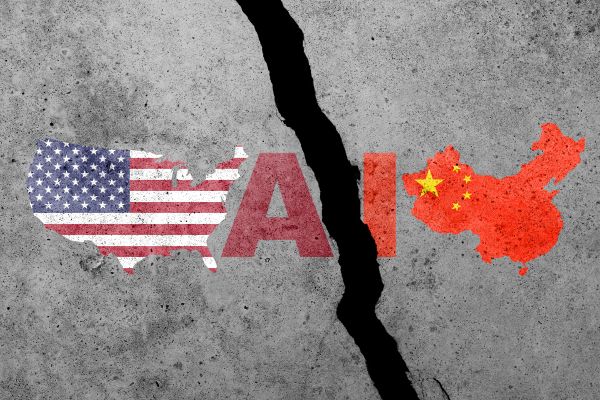
[Digital Today reporter Chi-kyu Hwang] Demand is rising for Chinese open-source AI models that are relatively cheap but deliver performance close to OpenAI and Anthropic, driven by AI costs.
Chinese open-source models are also making inroads into leading U.S. tech companies. Interest among U.S. tech firms appears to be growing further since Chinese AI startup Z.ai recently released the GLM 5.2 model.
Coinbase, the largest U.S. cryptocurrency exchange, is testing setting Chinese companies’ open-weight models such as Z.ai’s GLM 5.2 and Moonshot AI’s Kimi 2.7 as default models in its LLM gateway. Engineers can still freely choose the models they want.
Yu Chen Jin (유첸 진), who oversees AI system and product development at cloud-based data platform company Databricks, recently wrote on social media platform X (Twitter), “GLM-5.2 is the open-source Claude moment.” “The demand we’re seeing at Databricks is astonishing, and the world will witness large-scale adoption of open-source LLMs,” he said.
According to Axios, Microsoft is reviewing a fine-tuned version of DeepSeek V4 or other open-source models as cheaper alternatives to the Anthropic and OpenAI models it uses to run Copilot Cowork.
The test shows Microsoft is pursuing a multi-model strategy rather than relying only on OpenAI and Anthropic models. If Microsoft adopts DeepSeek, customer data will remain within Microsoft’s cloud and be subject to Azure enterprise security, compliance and data residency controls.
Perceptions of Chinese AI models have moved well beyond being merely usable at low prices. Some benchmarks have also released results showing them outperforming OpenAI or Anthropic. It is also cited as a factor expanding the share of Chinese AI models that the U.S. government is imposing controls on deployments of the latest AI models from Anthropic and OpenAI for safety reasons. Most Chinese AI models are open source, so they can be downloaded for free, modified and used where needed.
Xiaoyin Qu (샤오인 취), a serial entrepreneur in Silicon Valley and former product manager at Meta and Instagram, expects the potential of Chinese models to grow further.
Writing on X, he said U.S. and European companies will abandon OpenAI and Anthropic and adopt Chinese models, citing four reasons.
First, he said companies can meet compliance requirements while securing control over data by running Chinese models on their own GPUs. Second, he said additional training using their own data on top of Chinese models can build competitiveness in their own data.
Third, he cited a lack of trust that Anthropic could take customer data and enter businesses directly, such as healthcare and law, just as it suddenly blocked access to the Fable5 model for safety reasons.
Fourth, he highlighted that companies are under pressure to prove returns on AI investment. “The solution is a trustworthy U.S.-made open-source model, but there is no such model at the moment,” he said. “If you believe handing all data and AI control to Anthropic and OpenAI means safety and compliance, that is naive,” he said.
OpenAI and Anthropic still focus on closed models. OpenAI has introduced open models that disclose weights like Chinese companies, but its center of gravity remains on closed models, and Anthropic keeps its distance, saying an open-source strategy is risky.
Even so, the rise of Chinese companies fronting open-source models is an unwelcome scene for OpenAI and Anthropic, which are pursuing listings. If they do nothing, their market share could shrink, and if they counter with price, investor pressure could grow around profitability. The two companies appear to be strengthening cost efficiency while maintaining a closed-model-centered structure.
Anthropic on the 1st unveiled Sonnet 5, a mid-sized model that provides performance close to Opus 4.8 while being available at a lower cost. The Information reported that OpenAI developed an optimization technology that cuts AI model inference costs to less than half.
 Chi-kyu Hwang
delight@d-today.co.kr
Chi-kyu Hwang
delight@d-today.co.kr