
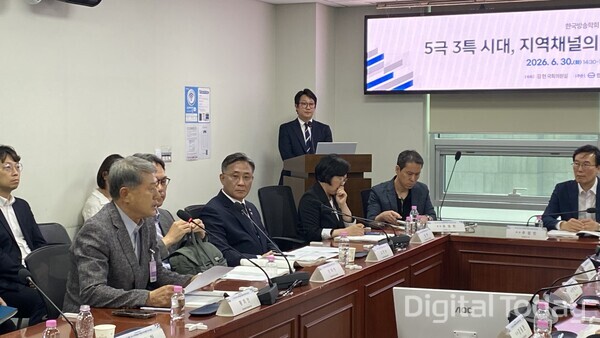
The cable TV system operator (SO) industry urged the government to ease the burden of the broadcasting development fund, stressing local channels' role as public infrastructure.
The Korean Association for Broadcasting & Telecommunication Studies and the Korea Cable TV Broadcasting Association held a seminar titled "In the era of five poles and three specials, the role of local channels and the future of cable TV" on June 30 at the National Assembly Members' Office Building, hosted by Democratic Party lawmaker Kim Hyun (김현).
"Five poles and three specials" is a regional balanced development policy that is a core state task of the Lee Jae-myung government. It aims to reorganise national space into five mega economic zones - the Seoul metropolitan area, Chungcheong, Southeast, Daegyeong and Honam - and three special self-governing provinces: Gangwon, North Jeolla and Jeju. The SO industry says institutional support is needed in line with the government's policy direction because local channels serve as local public infrastructure through community-focused reporting, lifestyle content, vote-count broadcasts and disaster broadcasting.
Hwang Hee-man (황희만), chairman of the Korea Cable TV Broadcasting Association, said in welcome remarks that the five poles and three specials plan is not simply an administrative reorganisation. He said it is about creating a framework for decentralisation so regions can protect their own lives and culture in response to concentration in the capital area. Hwang said cable TV SOs have served as a local public forum for more than 30 years, from local council election vote counts to coverage of local issues and content reflecting residents' voices during local disasters.
Hwang said regulation differs by platform even when the same service is provided, and the broadcasting development fund burden remains. He urged the government and the National Assembly to resolve regulatory imbalance.
The SO industry expressed regret that a plan to lower the broadcasting development fund levy rate, reviewed to the point of a conclusion by the previous主管 ministry, the Ministry of Science and ICT, was not carried over as is to the Broadcast Media and Communications Commission. The ministry is known to have reviewed, to the point of a conclusion, a plan to cut the levy rate for SOs to 1.3 percent from 1.5 percent. The commission is taking the position that separate discussion is needed.
SO local channels beat terrestrial broadcasters in coverage intensity at basic administrative level
Kim Yeon-sik (김연식), a professor in the Department of Media Communication at Kyungpook National University, and Hwang Kyung-ho (황경호), a professor in the Liberal Studies Division at Kyungnam University, presented analysis findings that local channels serve as hyperlocal infrastructure, citing Seogyeong Broadcasting and JCN Ulsan Jungang Broadcasting as examples. They presented as evidence a hyperlocal media index (HMI) newly developed in this research.
The HMI measures, on a scale of 0 to 100, how finely a news source location covers administrative districts and living spaces. Non-local and nationwide coverage scores 0, broad regional coverage 25, city, county and district coverage 50, town and neighbourhood coverage 75, and village and living-space coverage 100.
In results calculated for 8 broadcasters in South Gyeongsang and Ulsan, Seogyeong Broadcasting scored highest at 48.48, and JCN Ulsan Jungang Broadcasting ranked second at 46.73. They outperformed local terrestrial and private broadcasters including KBS Changwon (46.50), MBC Gyeongnam (45.83), KNN (43.19), UBC Ulsan Broadcasting (42.52), Ulsan MBC (41.49) and KBS Ulsan (40.34).
The same result was found in the share of reporting at the basic local level. Seogyeong Broadcasting had the highest ratio of city and county-level basic-area reporting among the 8 broadcasters at 72.78 percent. Of 584 news items in the South Gyeongsang area, 322 were basic-area reports, and Seogyeong Broadcasting accounted for 128 of them, or 39.8 percent, exceeding KNN at 17.1 percent, KBS Changwon at 23.0 percent and MBC Gyeongnam at 20.2 percent.
JCN Ulsan Jungang Broadcasting ranked first among the 8 broadcasters in both the hyperlocal reporting ratio at 26.03 percent and the living-space reporting ratio at 24.20 percent. Its share of basic-area reporting in the Ulsan region was also higher at 38.7 percent than UBC Ulsan Broadcasting at 25.8 percent, KBS Ulsan at 19.4 percent and Ulsan MBC at 16.1 percent. Professor Hwang said cable SO local channels outperformed terrestrial and private broadcasters in the same region in both the volume of basic-area local reporting and coverage intensity.
"Public responsibilities such as disaster broadcasting are clear... financial difficulties need to be resolved"
Concerns were also raised about hollowing out of local channel content. Academic research shows SO local channels mostly maintain all-day schedules, but the share of rotating schedules that repeatedly air the same content is increasing, while production costs are trending down.
The SO industry is also stressing that it still fulfills mandatory disaster broadcasting. Disaster broadcasting is a public responsibility carried out only by SOs among paid TV operators. It is considered broadcasting infrastructure that must operate until the end even if communications and the internet are cut off.
Professor Yoo Kyung-han (유경한) of Jeonbuk National University stressed that SOs invest 119 billion won annually in local channels and air about 70,000 disaster broadcasts a year, but their public contribution is not institutionally recognised, creating a mismatch between contribution and recognition.
He then proposed establishing a "Local Communication Promotion Fund" that bundles the broadcasting development fund, the local feedback portion of licence fees and matching funds from local finance as a funding measure.
Broadcast Media and Communications Commission says budgets from other ministries also possible if SOs defined as "local infrastructure"
The commission also appears to recognise the need for a promotion fund. It said, however, that securing funding must come first following a cut in the SO levy rate for the broadcasting development fund.
Kang Dong-wan (강동완), director of the commission's New Media Policy Division, said the rationale for raising funds needs to be strengthened. He suggested that if the SO role is expanded into a public service hub for local communities covering education, welfare and safety, discussions could also be linked to budgets under the purview of the Ministry of Health and Welfare, the Ministry of Education and the Ministry of the Interior and Safety, in addition to the broadcasting development fund.
On the HMI, he said continued supplementation is needed so it can reflect various factors together, including not only content production but also user reach, resident participation and contribution to local communities, in order to be used in policy.
Kang said the commission is operating an expert research group to prepare measures to revitalise paid TV and is reviewing ways to strengthen the competitiveness of the paid TV industry and improve systems. He said opinions presented in the day's presentations and discussions would also be actively referenced in the process of reviewing future policy.
In response, Kim called on the commission to quickly discuss policy. He said that when cable broadcasting moved from the Ministry of Science and ICT to the commission, there was a fundamental qualitative change, and it is an issue that requires setting direction with the entire broadcasting ecosystem in mind.
Kim said it is a rapid agenda that should be reviewed by the commission's Regional Broadcasting Development Committee, not an expert research group. He said operating a research group takes two years to reach system implementation, meaning no conclusion would be reached within the term of Chairman Kim Jong-chul (김종철).
 Seulgi Son
sageson@d-today.co.kr
Seulgi Son
sageson@d-today.co.kr