
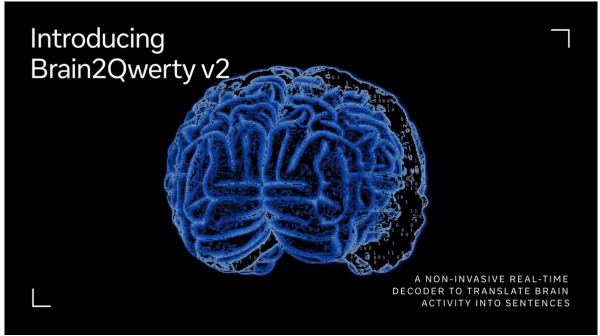
Meta has unveiled a noninvasive brain-computer interface (BCI) AI system called Brain2Qwerty v2 that converts brain activity into text without brain surgery. Average word accuracy was 61 percent, a level seen as a sharp improvement over existing noninvasive methods.
On June 29, blockchain media outlet Decrypt reported that Meta recently announced Brain2Qwerty v2, a noninvasive AI-based brain-signal decoding system. Meta said the work is research intended to help people who have lost the ability to communicate due to brain disease or brain injury express what they want to say.
Brain2Qwerty v2 works by measuring brain activity using helmet-shaped magnetoencephalography (MEG) equipment and having an end-to-end AI model analyse raw neural signals to reconstruct the sentence a user intended to type. Meta said it fine-tuned a large language model (LLM) to neural data so it can restore context-aware text even from noisy brain signals.
Nine volunteers took part in the study. Participants actively typed while wearing the MEG device, and researchers collected about 10 hours of brain-activity data per participant. Meta said it trained Brain2Qwerty v2 using about 22,000 sentences. The company stressed it used an end-to-end deep-learning architecture in which AI learns directly from raw brain signals rather than having humans extract neural events as before.
Performance also improved sharply. Brain2Qwerty v2 recorded an average word accuracy of 61 percent, far above the roughly 8 percent level posted by earlier noninvasive methods.
Meta said it confirmed a tendency for decoding accuracy to rise as more training data are added, and said performance could improve further if it secures additional data. It also said it developed the model in a way that AI agents automatically explored various training pipelines and researchers selected the optimal configuration.
Meta released the research results along with training code for Brain2Qwerty v1 and v2. Research partners plan to release the Brain2Qwerty v1 dataset as well, as part of Meta's Digital Brain Project. Meta also runs a $5 million research-support fund to expand open neuroscience datasets.
Researchers published the paper in the journal Nature Neuroscience. The paper said most current high-performance BCIs rely on surgical methods that insert electrodes into the brain, and pointed out that such approaches have limits to broader adoption due to surgical risks and long-term maintenance issues.
Meta said Brain2Qwerty v2 is gradually approaching the accuracy levels achieved by BCIs that require surgery, and said it expects noninvasive technology to help narrow the gap between surgical neural prosthetics and existing non-surgical communication systems. The company said, "By conducting this research openly, we hope it will help the neuroscience field contribute to faster diagnosis and treatment of neurological diseases."
In the brain-computer interface market, competition in both surgical and non-surgical technologies has been accelerating at the same time. Elon Musk's Neuralink and Synchron are developing implantable BCIs, and Merge Labs, backed by Sam Altman, is also developing technology aimed at restoring communication for patients with neurological diseases.
Noninvasive technologies are also advancing rapidly. In 2024, Neurable unveiled AI-based EEG headphones that measure concentration and cognitive fatigue, and later MIT spinoff AlterEgo introduced a wearable device that converts neuromuscular signals from the face and neck into text and commands.
The industry is assessing Meta's announcement as an example showing the race to decode brain signals is rapidly expanding from a focus on surgical devices to AI-based noninvasive technology. It is expected that as more training data and open datasets are secured, the accuracy and range of real-world communication assistance technology will expand further.
 Jinju Hong
hongjj@d-today.co.kr
Jinju Hong
hongjj@d-today.co.kr