
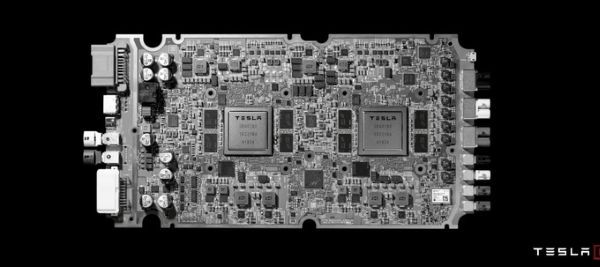
Tesla has begun rolling out Full Self-Driving (FSD) v14 Lite for HW3 vehicles.
On June 29, local time, electric vehicle outlet Electrek reported that this is the first large-scale update for about 4 million HW3 vehicles that have remained on FSD v12.6 since early 2025.
The initial rollout is for early-access program users. Ashok Elluswamy (애쇼크 엘루스와미), Tesla's head of artificial intelligence (AI), said on social media platform X, formerly Twitter, that FSD v14 Lite is being distributed to AI3 early-access customers. AI3 is Tesla's internal name for HW3. The firmware version for this build is 2026.20.5.1.
The key point is that it implements driving performance from the HW4-based v14 line in an environment suited to HW3. Elluswamy explained that this build is an optimized version of AI4's v14 series driving model tailored to AI3's cameras and computing capability. He said it supports destination setting and speed profiles in city driving and, above all, safety has improved significantly.
In its release notes, Tesla explained that it transplanted HW4's v14 intelligence to HW3 so older computers can learn from a range of driving situations. As a result, some reinforcement-learning and offline-model improvements have been applied, and performance has improved in navigation processing, lane merging and splitting, and responses to pedestrians. Parking, pulling out and reversing functions have also been newly added.
Still, the update does not resolve the fundamental limitations of HW3 vehicles. As the name itself is FSD 'Supervised' v14 Lite, it remains a Level 2 driver-assistance system in which the driver must stay attentive at all times and be able to intervene immediately. HW3 vehicles have not gained support for unsupervised self-driving.
The issue has drawn more attention after Tesla recently officially acknowledged HW3 performance limits. Tesla has marketed FSD packages for up to $15,000, promoting that millions of vehicles sold since 2019 had all the hardware needed for fully autonomous driving. However, Elon Musk acknowledged in the first-quarter 2026 earnings call that HW3 vehicles "just" do not have the ability to run unsupervised FSD. HW3 chip memory bandwidth is known to be about one-eighth of HW4's.
Tesla later mentioned the possibility of building dedicated microfactories to replace HW3 computers and cameras, and it belatedly added the term supervised to earlier FSD contract wording. In this situation, v14 Lite was a step previewed in April to ease backlash from HW3 users, and deployment began near the end of the June target deadline.
Market and user attention is focused on a broader rollout and compensation issues. Elluswamy said distribution will expand to a wider range over the next few weeks. Since FSD v14 has already been launched in Europe and Australia, the possibility has been raised that it will be expanded to HW3 vehicles in those regions as well.
Legal pressure, meanwhile, is growing. In the Netherlands, the number of participants in a class claim citing unfulfilled promises related to HW3 has increased to about 7,000, and formal legal action is also being pursued. As a result, Tesla continues to face the issue of replacing computers in about 4 million vehicles or compensating owners. The update does mean improved driving performance, but the lack of unsupervised self-driving that HW3 buyers expected after paying costs is likely to remain a key issue.
FSD v14 Lite is now rolling out to AI3 early-access customers. Based on the feedback, will rollout to more customers over the next few weeks. This build distills the driving behavior from AI4’s v14 series into both the camera and compute config of AI3. It includes destination…
 Seung-a Yoo
ysah@d-today.co.kr
Seung-a Yoo
ysah@d-today.co.kr