
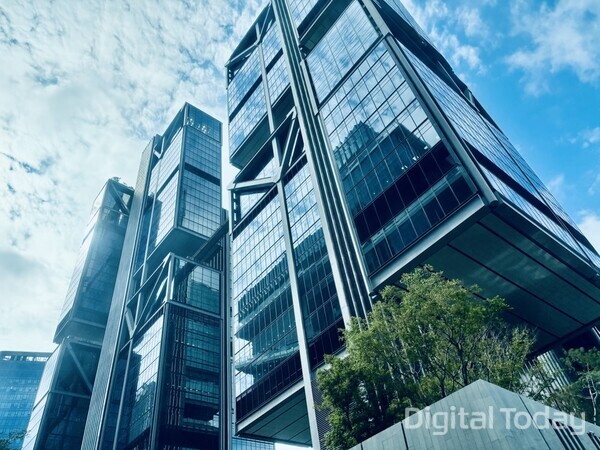
[Shenzhen, China = DigitalToday reporter Suk Dae-gun] DJI's SkyCity headquarters rises in the middle of Shenzhen's skyline, true to its name. SkyCity is where DJI develops its entire product lineup, starting with flight and extending to the ground and the home. The reporter toured the site through a media tour arranged by DJI on June 11.
DJI is defining itself as a company that works with imaging, not just a drone company. It explained that its expansion in products, from aircraft to gimbals and cameras and then down to robot vacuum cleaners and transport carts, all stems from the broad pillar of imaging.
SkyCity was designed by global architecture group Foster and Partners. It is a twin-tower complex of 44 and 40 floors, reaching about 200 metres in height. The two buildings are linked at a height of 105 metres by a 90-metre-long skybridge. DJI said it was built to bring employees and staff scattered across multiple buildings into one space. Founder and CEO Frank Wang said the new headquarters took six years to build, adding that he sees SkyCity as a true home unlike any product the company has made so far.
SkyCity's design reflects DJI's corporate philosophy. Workspaces protruding outward from a central core give the impression, from a distance, that the building is floating in the air. The skybridge connecting the two towers is said to represent all departments collaborating organically toward a shared goal. Below the building is a sloping garden that lets surrounding greenery flow naturally into the interior, and parts of the first floor are also open to the public. Features aimed at sustainability are applied throughout, including collecting and reusing rainwater and maximising natural daylight.
Around the building, it was clear how far DJI has extended from its start in imaging. The starting point is flight. DJI actively uses drones in agriculture, and an agricultural drone is said to be used at a level that replaces 40 people. As flying devices take over tasks such as pest control and seeding that used to be done by hand, it effectively changes the way work itself is done. Drones are not limited to agriculture. They have expanded into public areas such as traffic control and patrols, and are also said to be used with 200x zoom to identify and respond to situations at a distance. As a single device replaces work that used to require several people, drones were moving beyond hobby gear to become productivity tools at industrial sites.
◆DJI: "User-focused rather than aiming to surpass someone"
Technology honed in flight has come down to the ground. Handheld gimbals and action cameras, as well as pocket cameras that fit in one hand, are part of that extension. Taking a step further, DJI has also moved into the home. The result is the second-generation robot vacuum cleaner ROMO, unveiled this year following the first generation last year. DJI said it aims to bring sensing, avoidance and path decision technologies accumulated in the air into the home, so users can do less housework.
The lineup from drones to gimbals and then robot vacuums may look unrelated, but they share the same roots in that moving devices perceive their surroundings and make their own decisions. The robot vacuum market already has several established leaders, but DJI said that as a latecomer it can more clearly identify unmet user demand, presenting that as a strength. It said it applied sensing technology honed in the air to millimetre-level obstacle avoidance, allowing the device to avoid small cards and even transparent liquids.
◆R&D delves beyond imaging into sound and vibration
DJI's research does not remain limited to flight or imaging. It is known to devote significant effort to precisely refining a product's video and sound in controlled environments. It does this by capturing and reducing even faint noises made by devices in soundproof spaces and repeatedly verifying stabilisation performance that filters out shaking. That means it is broadly delving into even less visible technologies such as sound and vibration control. It is reported that layered verification processes underpin imaging devices including the Pocket series.
The trend of DJI expanding its business around imaging is also supported by results. Japan is a representative market. According to market research firm BCN, Pocket 3 has maintained the top sales spot in Japan's video camera market for 20 consecutive months since its October 2023 release, and its market share reached 34.1 percent as of June 2025. That means 1 out of every 3 video cameras sold in Japan was a Pocket 3. Pocket 4, released in April this year, recorded a 21.5 percent share in nine days, and over the same period DJI's overall imaging product lineup accounted for 72.5 percent of the market in Japan. Performance in drones also stands out. The company's first panorama drone, Avata360, released in March this year, is reported to have secured a share of more than 98 percent of the global panorama drone market in a little over two months.
DJI stressed that it does not aim to surpass any particular company. It said it places more weight on delivering a better product experience based on a user-focused approach and innovation, rather than following someone. Targeting users who enjoy outdoor activities and filming as its core audience, it plans to release products that move across flight, ground and the home around the axis of imaging. SkyCity is close to a space that translates that plan into architecture. Attention is focused on how far this company's expansion, which began with imaging, will extend.
 Suk Dae-gun
d2dg@d-today.co.kr
Suk Dae-gun
d2dg@d-today.co.kr