
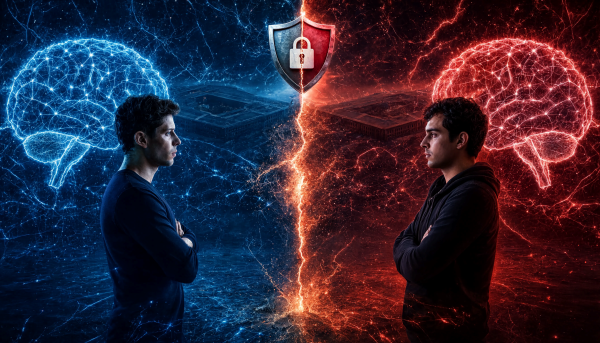
A report says a feud between OpenAI CEO Sam Altman (샘 알트먼) and Anthropic CEO Dario Amodei (다리오 아모데이) has lasted for about 10 years since 2016.
On June 28, online outlet Gigazine reported that the conflict led to splits inside OpenAI, the founding of Anthropic and the formation of the current artificial intelligence (AI) competitive landscape.
More recently, the two companies’ responses over a U.S. Department of Defense contract were contrasted again. Anthropic rejected a Defense Department request to roll back some of the safety safeguards it had put in place. Amodei did not accept the request, saying he does not yield to threats. U.S. President Donald Trump later ordered federal agencies to stop using Anthropic technology and designated the company as a supply chain risk target.
OpenAI, by contrast, reached an agreement with the Defense Department while maintaining safety standards that were effectively at the same level as the conditions Anthropic rejected. OpenAI said it applied restrictions that were almost identical to Anthropic’s, including provisions barring the use of AI technology for mass surveillance in the United States. But Amodei claimed in an internal email that OpenAI was more interested in persuading Defense Department officials, while Anthropic focused on preventing actual misuse and abuse. He criticised OpenAI’s explanation as an "outright lie."
The conflict between the two predates the founding of Anthropic. After joining OpenAI in 2016, Amodei clashed with co-founder Gregory Brockman (그렉 브록만) over the direction of AI development. Brockman argued that related details should be disclosed to the public, while Amodei countered that sensitive information such as development speed should be shared with the government first.
The dispute also spread to organisational management and business strategy. After Elon Musk demanded evaluations of employee contributions in 2017 and about 10 to 20 percent of staff were fired, Amodei viewed it as an excessively brutal restructuring. In the same year, when Brockman outlined a plan to sell artificial general intelligence (AGI) to governments, Amodei considered selling AGI to hostile countries an act close to treason and was reported to have even considered quitting.
After Musk left in 2018, Altman became the de facto leader, but internal conflict did not ease. Amodei stayed on under the condition that Brockman and Ilya Sutskever (일리야 수츠케버) would not become the people in charge, but later concluded Altman had not kept that promise. When GPT development began, he opposed Brockman’s participation in the project. His younger sister Daniela Amodei (다니엘라 아모데이) took the same position, and Brockman ultimately could not join the project.
In the end, about 10 people led by Amodei left OpenAI in late 2020. Altman tried to persuade them to stay, but Amodei demanded authority to report directly to the board and the condition that he would not work with Brockman, and the talks broke down. Amodei and Daniela Amodei later founded Anthropic.
In February this year, the feud again drew attention at the India AI Impact Summit. As Indian Prime Minister Narendra Modi (나렌드라 모디) raised the hands of Altman and Google CEO Sundar Pichai (순다르 피차이), most participants on stage held hands with one another, but Altman and Amodei did not shake hands. Altman later said he did not know what was happening on stage at the time.
 Yu Seung-a
ysah@d-today.co.kr
Yu Seung-a
ysah@d-today.co.kr