
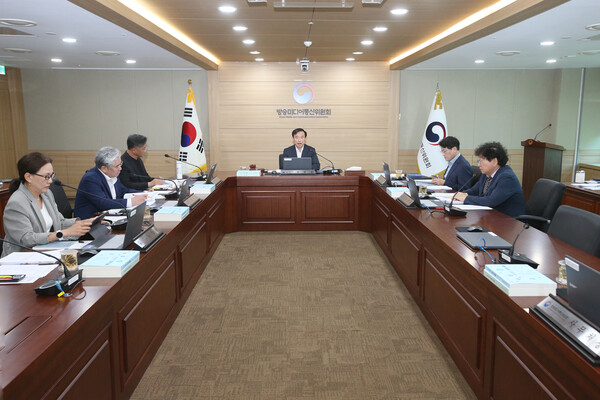
South Korea's Broadcasting Media and Communications Commission on June 29 approved a revision to a public notice to expand disability broadcasting from the visually and hearing impaired to all people with disabilities. The revision also imposes a new obligation on online video services (OTT) to make efforts to provide disability broadcasting.
The commission held its 20th plenary meeting of 2026 and passed the revision to the notice on scheduling and provision of disability broadcasting and guarantees of broadcasting access rights for people with disabilities.
Key changes include expanding access rights to broadcasting media for people with disabilities, improving diversity and quality of disability broadcasting programmes, and rationalising regulation.
The existing notice applied only to the visually and hearing impaired, but the revision expands the scope to all people with disabilities with physical or mental limitations under the Act on the Prohibition of Discrimination against Persons with Disabilities and Remedy against Infringement of Their Rights. It also newly imposes an obligation on OTT services to make efforts to provide disability broadcasting.
On scheduling, it added an obligation to make efforts to schedule disability broadcasting during prime viewing hours of 1900 to 2300 on weekdays and 1800 to 2300 on weekends and holidays. It also changed the method of calculating scheduling performance for multi-channel operators designated as mandatory operators from the average across all channels to having at least 80 percent of the mandatory scheduling ratio for each channel.
It also added a new item, "matters related to improving the quality of disability broadcasting", to matters to be reviewed and decided by the Disability Broadcasting Viewing Guarantee Committee.
As part of regulatory rationalisation, it simplified the criteria for designating mandatory disability broadcasting providers to a single standard based on broadcasting revenue, from a method that listed broadcasting revenue alongside disability broadcasting production costs. It also reduced performance evaluations from twice a year to at least once a year.
Commission Chairman Kim Jong-cheol (김종철) said he expected the revision to lead to high-quality disability content being provided through a variety of scheduling times and platforms. He said the commission would communicate actively to ensure people with disabilities are not left out and that their broadcasting access rights can improve.
The commission also announced the results of its evaluation of compliance with disability broadcasting provision obligations in 2025. It assessed scheduling performance for closed captions, audio description and Korean Sign Language broadcasting for 108 mandatory providers designated under the Broadcasting Act.
All providers complied with obligations for audio description and Korean Sign Language broadcasting, and many providers including terrestrial broadcasters exceeded mandatory scheduling volumes. However, it found that some of the 12 providers with an obligation to provide closed captions 100 percent fell short in part.
The commission plans to apply disability broadcasting production cost support on a differentiated basis for providers that fell short. It also plans to adjust scoring related to disability broadcasting scheduling in broadcasting evaluations.
Detailed results for 2025 compliance with disability broadcasting scheduling obligations will be posted on the websites of the commission and the Audience Media Foundation.
 Seulgi Son
sageson@d-today.co.kr
Seulgi Son
sageson@d-today.co.kr