
The government will foster semiconductors, physical AI and AI data centres as national growth engines based on large private-sector investment by companies including Samsung Electronics and SK. It aims to develop foundation models with a goal of becoming No. 1 in physical AI and expand AI data centres on the back of private investment.
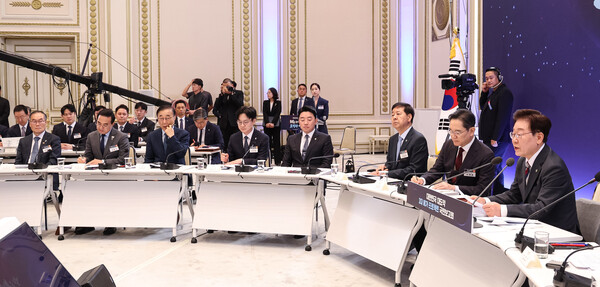
President Lee Jae-myung (이재명) chaired a public briefing on the "Three Megaprojects for a Great Leap Forward for South Korea" at the state guest house at Cheong Wa Dae on June 29. Attendees included relevant ministries such as the Ministry of Trade, Industry and Energy and the Ministry of Science and ICT, as well as Samsung Electronics, SK, LG Electronics, GS, KT, FuriosaAI, Robotis and HD Hyundai Robotics.
The government unveiled investment plans and support measures for semiconductors, physical AI such as AI robots, and AI data centres. It sees semiconductors as AI's brain, physical AI as an intelligent body and AI data centres as a storehouse of thought, and plans to combine the three fields organically.
Lee said, "I will place a direct supervising officer in Cheong Wa Dae for these projects and personally oversee the three megaprojects so they can be executed quickly."
◆Bring forward Samsung, SK fab construction to expand memory output
In semiconductors, the government will pursue a "3S+1F strategy" centred on production speed, regional hubs and securing a lead in next-generation markets. It plans to shorten the construction period for production facilities at Samsung Electronics and SK hynix and double South Korea's memory DRAM production capacity within the next 5 years. Samsung Chairman Jay Y. Lee (이재용) and SK Group Chairman Chey Tae-won (최태원) attended the briefing and shared the plan.
Samsung Electronics will build its Pyeongtaek Lines 5 and 6 simultaneously instead of sequentially. That will shorten the production-line buildout by 3 to 4 years compared with the previous plan. It will also bring forward the completion date of the last fab in the Yongin semiconductor cluster. A Yongin national industrial complex involving Samsung will be moved up by 7 years, and SK hynix's Yongin general industrial complex by 12 years. The government plans to supply key infrastructure such as electricity, water and roads on time. It will expand semiconductor production bases from the Seoul metropolitan area to across the country. Samsung Electronics and SK hynix will invest a combined 800 trillion won in the southwest region to build 4 memory fabs in total, 2 each.
The government will develop the Jeonnam-Gwangju Integrated Special City as a second semiconductor production base after the Seoul metropolitan area. It plans to shorten facility construction by supporting permitting, land acquisition and power and water supply. It will invest a total of 81 trillion won in the Chungcheong region to build a high-bandwidth memory, or HBM, packaging hub. It will support Samsung Electronics and SK hynix so that new HBM fabs in Onyang and Cheonan and HBM packaging investment in Cheongju proceed on time. It will foster the southeast and Daegyeong regions, including Busan and Gumi, as innovation hubs for power semiconductors and key materials, components and equipment.
The government will invest more than 30 trillion won over the next 15 years in future markets such as next-generation memory, on-device and on-sensor AI chips, chips for AI servers and defence semiconductors. It plans to build end-to-end support from research and development through design, demonstration and manufacturing. Under a special semiconductor law, it will also activate national-level support systems including a presidential special committee to strengthen semiconductor competitiveness, a special semiconductor account and a semiconductor innovation support task force.
◆Top 3 globally in AI robots... build mass-production hubs in Saemangeum, Daegyeong
In physical AI, the government will pursue a "3M strategy" combining strengths in manufacturing and the robot industry. The goal is to become one of the global top 3 in AI robots by accelerating AI transformation in manufacturing (M.AX), securing competitiveness in core technologies (Master), and building a region-led mass production system (Mass Production).
The government will apply manufacturing know-how by industry to AI robots and develop 10 industry-specific humanoids with a goal of commercialisation in 2028. Linked to the AI factory programme, it plans to deploy AI robots at 1,000 manufacturing sites each year and foster them as export products. To secure robot training data, it will build data factories for 10 industries and develop a Korean robot foundation model.
It will also push a dedicated R&D programme for three vulnerable components with low localisation rates: actuators, robot hands and sensors. In areas where South Korea is strong, such as semiconductors and batteries, it will develop robot-specific components and train 10,000 robot specialists over the next 5 years. It will build mass-production foundations around two pillars, Saemangeum and the Daegyeong region. In Saemangeum, it will create a robot foundry and parts cluster to support production by robot startups that lack manufacturing capabilities. In the Daegyeong region, it will build a robot test field linked to the automobile, shipbuilding and electronics industries. It will also support technology development and demonstration so auto-parts companies can shift into robot-parts companies.
The government will create an early market by pre-emptively buying robots for public sectors such as education, defence and disaster response. It will also use the National Growth Fund and other tools to support companies' investment in new and expanded production facilities. It will also pursue measures to foster physical AI as an irreplaceable national strategic industry. The government aims to become No. 1 globally in physical AI by 2030. Deputy Prime Minister Bae Kyung-hoon (배경훈), who also serves as science minister, said, "To become No. 1 in physical AI, the next 3 years will be the golden time," adding, "We will foster physical AI as a national strategic industry."
To that end, it will build a world model and digital twin infrastructure that reflect physical laws to produce large-scale synthetic data. It will also pool industry-academia-research capabilities to develop an independent physical AI foundation model within the next 3 years. It will demonstrate South Korean physical AI technology in major areas including manufacturing, caregiving, agriculture, safety and defence, and push exports of a full-stack physical AI offering spanning data, models, hardware, networks and security.
◆SK, GS, Naver to invest 550 trillion won in AI data centres
In AI data centres, SK, GS and Naver will invest about 550 trillion won, including capital raised from investors.
SK will first build a 1 gigawatt AI data centre in Ulsan and review additional sites in the central region, the Daegyeong region, the Honam region and the Gangwon region. SK will also pursue a second-phase project to expand a 5 gigawatt AI data centre built in the first phase to 15 gigawatts by 2035. GS will build a 2.4 gigawatt AI data centre in Donghae, Gangwon province, and Naver will build a 1 gigawatt AI data centre centred on areas including Sejong.
The government aims to complete site selection and permitting procedures early, start construction in the first half of 2028 and begin phased operations from 2029. The government will use the large-scale AI data centres built this way as testbeds for South Korean AI semiconductors and servers, networks, storage devices and power and cooling solutions.
Bae said, "An investment of 550 trillion won in AI data centres corresponding to 8.4 gigawatts is planned through 2029," adding, "After that, we will add 10 gigawatts through 2035 to push total investment of more than 1,000 trillion won for 18.4 gigawatts."
He also said, "AI data centres will serve as the heart that makes AI run," adding, "We must apply AI to all solutions and advance and scale up equipment for AI data centres."
The government will verify domestically made neural processing units, or NPUs, and power and cooling solutions in actual data centres and link them to securing demand at home and abroad and exports. It will develop and advance server, network and storage technologies, demonstrate them at domestic AI data centres and secure references to cooperate with global big tech companies. It will also strengthen cloud and software competitiveness, including GPU clustering, AI development tools and AI operations automation technology. It will also create an "AI data centre cluster" including a hyperscale testbed and form an alliance involving demand-side and supply-side companies.
◆20 trillion won public-private investment in manufacturing AI... target 100 trillion won in value added
The government also unveiled a "Road to a Great Transformation of South Korean Manufacturing: Manufacturing AI 2030 Strategy" in conjunction with the briefing. The core is to invest 20 trillion won jointly by the public and private sectors by 2030 to create more than 100 trillion won in economic value added in manufacturing.
The government will build a "national manufacturing data library" linking manufacturing data held by ministries and companies. It will apply standardisation, encryption and de-identification systems to prevent companies' core data from leaking outside. It will also link ministry-by-ministry data management systems through the manufacturing data library, including the industry ministry's AI factory manufacturing data, the science ministry's AI Hub and the Ministry of SMEs and Startups' AI manufacturing platform for small and medium-sized ventures, known as KAMP.
It will also convert "manufacturing tacit knowledge" into data, including work methods and process know-how of skilled workers nearing retirement. It will first allocate 48 billion won from this year's supplementary budget to related projects and expand them into regular budget programmes from next year. Based on accumulated manufacturing data, it will develop models in stages, from lightweight AI models that handle specific processes to mid-to-large manufacturing AI models that can be used across multiple industries and processes.
It will also develop a "manufacturing AI foundation model" that can be applied across operations. The leading AI factory programme will expand from a cumulative 102 cases in 2025 to more than 500 by 2030. The AI models developed will spread in the form of AI agents that can inspect and control manufacturing equipment using natural language.
◆Build autonomous factories combining AI agents and humanoids
In the advanced stage of manufacturing AI, the government will develop "full-stack AI factory" technology combining large AI agents, humanoids and manufacturing physical AI. The concept is to implement autonomous factories in which AI controls and optimises manufacturing activities across the board, from product and factory design to validation and pilot production, production, and distribution and logistics.
It will also develop physical-law-based AI models and world models, equipment and robot linkage technology, low-latency, high-reliability communications networks and end-to-end converged security technology. It will create "M.AX clusters" in regional industrial complexes with shared infrastructure including demonstration testbeds, edge computing centres and communications networks. AI technology validated at large companies' factories and manufacturing AX methodologies will be spread to partner companies and small and medium-sized manufacturers. It will prioritise introducing AI and robots to hazardous processes with a high risk of safety accidents to improve working conditions.
To expand private investment in manufacturing AI, the government will use funds and guarantees and link them with the 150 trillion won National Growth Fund. It will also introduce a "manufacturing AX certification" system to foster specialised manufacturing AI companies. It will expand training for manufacturing AI specialists with master's and doctoral degrees and in-service training for workers who will use AI at manufacturing sites, and also push amendments to the Act on Promotion of Industrial Digital Transformation and Utilisation of Artificial Intelligence and the Smart Manufacturing Innovation Act for Small and Medium Enterprises.
The government will supply power and water needed to 추진 the three megaprojects on time. For the Yongin semiconductor industrial complex, it will use existing transmission lines as much as possible and build a power grid through undergrounding if needed. For the southwest semiconductor industrial complex, it will supply power using renewable energy and nuclear power and use alternative water resources such as multipurpose dams and power-generation water. For AI data centres, it will supply power by combining renewable energy, nuclear power and some fossil-fuel power sources depending on location. It also plans to swiftly process power system impact assessments for AI data centres outside the Seoul metropolitan area and introduce a dedicated electricity tariff system for AI data centres.
Bae said, "Manufacturing AI must go beyond simply applying AI to factories, and develop to a stage where AI understands physical phenomena and process flows on manufacturing sites and makes its own judgments to control equipment and robots."
Industry Minister Kim Jung-kwan (김정관) said, "M.AX is a key task that will determine the future competitiveness and survival of our manufacturing industry," adding, "It is important that each ministry responsibly carries out its tasks so the measures do not remain a simple report and lead to the creation of real value in the real world."
SMEs Vice Minister Noh Yong-seok (노용석) said, "The AI transformation of small and medium-sized enterprises is a prerequisite for a great AI transformation of South Korean manufacturing," adding, "We will develop smart factory support policies more intelligently to promote AI transformation across small and medium-sized manufacturing sites."
 Jin-ho Lee
jhlee26@d-today.co.kr
Jin-ho Lee
jhlee26@d-today.co.kr