
Samsung Electronics and SK Group are expanding semiconductor production bases into the southwest. Samsung Electronics will build four memory fabs in the southwest, which it has presented as a second semiconductor production base. SK Group cited investment totalling 2,100 trillion won, including about 1,000 trillion won for AI data centres and about 1,100 trillion won to expand semiconductor supply. Of that, 400 trillion won was allocated to a new cluster in the southwest. A memory supply shortage driven by surging artificial intelligence (AI) demand has triggered large-scale capacity expansion.
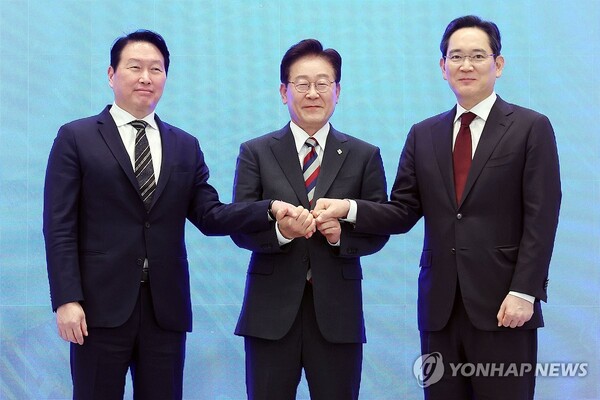
Samsung Electronics Chairman Lee Jae-yong (이재용) and SK Group Chairman Chey Tae-won (최태원) presented their groups' regional investment plans in person at the 'Republic of Korea Great Leap: Public Briefing on Three Mega-Projects' held at Cheong Wa Dae on June 29. Jun Young-hyun (전영현), vice chairman of Samsung Electronics and head of its DS division, and Kwak Noh-jung (곽노정), CEO of SK hynix, also attended.
Samsung Electronics memory fabs in the southwest; Gwangju under review as candidate site
Lee Jae-yong said Samsung Electronics is reviewing Gwangju as a candidate site for a new complex in the southwest. "Following Giheung, Hwaseong and Pyeongtaek, the investment schedule for the Yongin national industrial complex has been brought forward, and the timing to prepare a new complex has also been moved up," Lee said. "We are planning Gwangju as a candidate site, where we expect infrastructure and incentive support such as securing power, water and manpower," he added.
Samsung Electronics will not stop at production in the southwest and will disperse bases by business. It will concentrate high-bandwidth memory (HBM) fabs and semiconductor back-end processes in the Chungcheong region, including Cheonan and Onyang. It will place humanoid robots and an AI data centre for internal group use in Gumi, North Gyeongsang province; all-solid-state batteries and batteries for energy storage systems (ESS) in Ulsan, South Gyeongsang province; package substrates in Busan; and bio operations in Songdo, Incheon. It will continue its next-generation shipbuilding business in Geoje, South Gyeongsang province.
SK hynix: 600 trillion won for Yongin, 100 trillion won for Cheongju, 400 trillion won for southwest
Chey Tae-won laid out SK hynix's memory expansion plan by base. It will invest about 600 trillion won in Yongin to increase DRAM production and about 100 trillion won in Cheongju to increase NAND output. It will bring forward the Yongin cluster plan, which had been scheduled for completion in 2045, by 12 years. In addition, it will invest about 400 trillion won in the southwest, where conditions for power, water and manpower are met, to create a new cluster. "The memory semiconductor market already has an extreme supply shortage," Chey said. "The shortage will become even more severe," he added, stressing the need to expand supply.
SK is planning about 1,000 trillion won for AI data centres and about 1,100 trillion won to expand semiconductor supply. With SK Telecom as the محور, it will build AI data centres totalling 15 gigawatts (GW) in stages. In the first stage it will build 5 GW across multiple regions with power and sites, then sequentially expand by 10 GW in the second stage. It plans to execute average domestic investment of more than 100 trillion won a year over the next 10 years. "We will shift from a country that consumes AI to a country that exports intelligence," Chey said.
The corporate investment unveiled on the day aligns with the government's base strategy. The Ministry of Trade, Industry and Energy presented a plan to link the country into a semiconductor cluster by making the Seoul capital area and the southwest production bases, the Chungcheong region a packaging base, and the southeast and Daegyeong regions a base for materials, parts and equipment.
Some observers say investment allocated to the southwest alone could grow further. The SK hynix investment in a new southwest cluster announced by Chey Tae-won is 400 trillion won. In addition, total corporate investment of 800 trillion won that the government has presented as a "second semiconductor production base in the southwest" has been discussed.
If that 800 trillion won is added as Samsung Electronics' share, investment in the southwest alone is expected to exceed 1,000 trillion won. Since Lee Jae-yong cited Gwangju as a southwest candidate site but did not specify an investment amount, some analysis suggests the total for the southwest could grow further as Samsung Electronics' investment outline becomes clearer.
Policy support was also specified. The Ministry of Trade, Industry and Energy said it will double semiconductor production capacity in the Seoul capital area within 5 years and cut the timeline for fab construction that was planned for the mid-to-late 2040s by up to 12 years to the mid-2030s. It will invest 30 trillion won over 15 years in next-generation semiconductors. The ministry said, however, that at the current pace of fab construction, there is a risk South Korea's DRAM market share could fall to 50 percent from 61 percent.
The Ministry of Climate, Energy and Environment will supply 6.3 GW of power and 650,000 tons of industrial water to semiconductor plants in the southwest, and about 15 GW of power and 1.5 million tons of industrial water to the Yongin area. It is also reviewing the introduction of a regional electricity tariff system.
President Lee says speed is the only way out and he will oversee policy directly
In opening remarks, President Lee Jae-myung (이재명) said sites centred on Yongin and Pyeongtaek were already reaching their limits, citing shortages of power and water. "Speed is the only way out," Lee said, defining semiconductors, physical AI and AI data centres as "three pillars for a great leap."
Lee also said that Honam's long exclusion from development had instead become an opportunity factor. "The southwest coastal area is where water is abundant and, in particular, renewable energy is abundant," Lee said, explaining why companies chose the region as a base. He also said the announcement had special meaning because balanced development and demand for a new semiconductor base align.
Governance will also be overhauled. Lee promised to place a dedicated reporting officer for the three mega-projects directly under the presidential office at Cheong Wa Dae and oversee the projects himself. "I will personally take responsibility for swift one-stop administrative procedures," Lee said. He also mentioned state funding support for infrastructure construction costs through a special semiconductor law scheduled to take effect in August this year. It was reported that the Gwangju and South Jeolla region had taken the position that it could match integrated support funds of 5 trillion to 20 trillion won.
"We will deploy government capabilities on a large scale so that companies can invest without incurring losses and with a better outlook," Lee said. He also stressed that the results of the three mega-projects would underpin South Korea for the next 20 to 30 years.
 Dae-geon Seok
d2dg@d-today.co.kr
Dae-geon Seok
d2dg@d-today.co.kr